
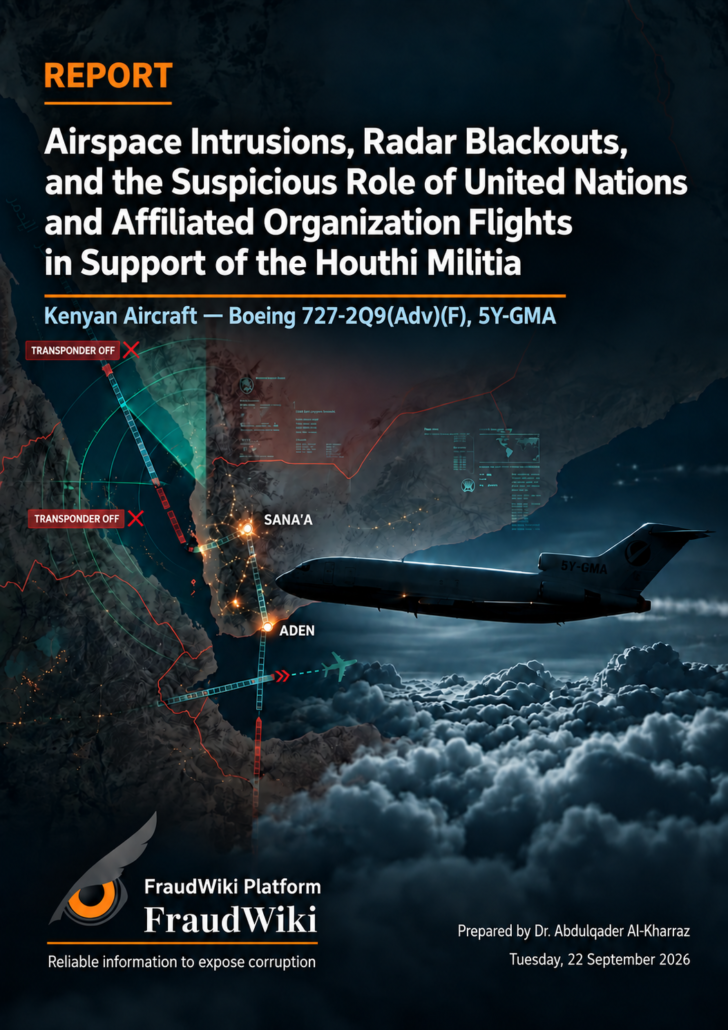
Report: Airspace Violations and Radar Concealment over Yemen — The Kenyan Aircraft 5Y-GMA
Prepared by Dr. Abdulqader Al-Kharraz
FraudWiki – 22 September 2026
The report documents the movements of the Kenyan Boeing 727-2Q9(Adv)(F), registered as 5Y-GMA and operated by Safe Air. It links these movements to those of UN aircraft and an aircraft operated by Médecins Sans Frontières (MSF), describing them as part of a “parallel air corridor” used to move sensitive cargo under humanitarian cover, beyond monitoring and inspection.
The Kenyan Aircraft’s Route
After departing Nairobi and manoeuvring in Kenyan airspace, the aircraft returned to the airport, then took off again heading north without a declared destination and with its transponder completely switched off.
The report records the following sequence of movements on 22 September:
09:15: The aircraft’s signal appeared for a few minutes over Yemeni territorial waters near Aden, following a deceptive track toward the city. This coincided with the departure of UN aircraft UNO132H from Djibouti.
09:17–09:35: The signal disappeared again near Aden, and the aircraft began penetrating Yemeni territory covertly. During the same period, radar showed UN aircraft UNO132H and MSF aircraft 3BNBZ.
09:53: Monitoring teams documented the Kenyan aircraft landing at Sana’a International Airport after entering Yemeni airspace without registration or inspection.
10:35: It took off from Sana’a heading south while concealed from radar.
11:10: The Kenyan aircraft’s signal reappeared near Aden, at the same point where it had disappeared that morning, as it headed toward Djibouti.
11:18: The aircraft switched off its transponder while flying at low altitude toward Djibouti airport.
12:35: Its signal appeared again as it departed Djibouti after a brief deceptive stop, then was switched off later.
12:49: The aircraft switched off its signal and remained concealed until it approached and landed at Nairobi airport.
Flights Operating at the Same Time
The report states that MSF aircraft 3BNBZ departed Djibouti without a declared destination, bypassed a landing in Aden, and passed through the city’s airspace before heading directly to Sana’a. It was not included in the approved UN flight schedule for September. On its return from Sana’a, it landed in Aden for about 40 minutes to legitimise its route, then departed for Djibouti at 12:35.
UN aircraft UNO132H deviated from its scheduled route: Djibouti – Aden – Riyadh – Seiyun – Aden – Djibouti. After landing in Aden, it flew to Al Mukalla, returned to Aden, and then departed for Djibouti.
What the Evidence Shows
The report links the direct Nairobi–Sana’a route, flown with the tracking device switched off, to the transport of highly sensitive cargo—military or specialised technical cargo—and the avoidance of inspection. It describes the aircraft’s stop in Djibouti on its return journey as cover intended to make the flight appear to have followed normal procedures, after the transfer and unloading had already taken place at Sana’a airport.
The report concludes that the simultaneous flights created deceptive air traffic over the Gulf of Aden and territorial waters to distract radar monitoring and conceal the cargo aircraft’s movements. It connects this activity to findings in its previous reports on deliberate radar concealment, the difference between the published flight schedule and a closed operational schedule, and the continued use of Sana’a airport by flights that have not undergone inspection under humanitarian and relief cover.
Connection to the 13 July 2026 Incident
The report confirms that the same Kenyan aircraft, operated by Safe Air, was observed in Sana’a on 13 July 2026. It arrived at 09:10 and departed at 10:07 while Sana’a airport was dark on radar. After it left, an aircraft operated by the International Committee of the Red Cross (ICRC) landed at the airport. The Houthi militia announced immediately upon its arrival that it had “detained” the aircraft.
The report links these simultaneous movements to an Iranian aircraft’s attempt to enter Yemeni airspace and land in Sana’a that same day. The Iranian aircraft later changed course and landed at Hodeidah airport amid strong warnings about air traffic. The report concludes that the repeated use of the Kenyan aircraft at pivotal moments takes these movements beyond “operational coincidence” and into the realm of collusion and direct coordination. It describes the aircraft as a “logistical spearhead” used to establish parallel air cover serving the Houthi militia.
Recommendations
The report calls for the location of the radar breach and the landing recordings to be submitted to coalition leadership and the relevant aviation authorities. It also calls on the Evacuation and Humanitarian Operations Cell (EHOC) to explain why aircraft 3BNBZ bypassed the expected landing in Aden and was not included in the September schedule. Finally, it recommends adding the video recordings and radar data to the “parallel air corridor” case file for the next human rights and media report.
#FraudWiki
Report in PDF
Kenyan_Aircraft_Report_English_with cover
