
FraudWiki, 26 August 2026
Introduction
This analytical report builds on more than a year of sustained fieldwork by the teams of the #We_Will_Not_Remain_Silent and #Where_Is_The_Money campaigns, led by Dr. Abdulqader AlKharraz, to monitor and track air traffic at Sana’a International Airport with precision. Since July 2025, the field and technical teams have worked to uncover the workings of the closed air corridor and to cross-check actual aircraft movements against data published by global flight-tracking platforms.
These efforts culminated in the publication of a major investigative report on FraudWiki in November 2025, entitled “The Parallel Air Channel: A Security Threat Hub and the Exploitation of Humanitarian Cover,” which laid the groundwork for understanding the methods and suspicious patterns used to operate flights beyond legitimate governmental and international oversight. The report also highlighted a stark paradox: the regular schedule of flights to Sana’a Airport, which average one flight per day and occasionally reach up to five flights daily. This high frequency contradicts the rationale for humanitarian operations, particularly in light of the Houthi militia’s crackdown on UN operations, the detention of its personnel, and the departure of a significant portion of its staff. The continuation of these frequent flights—while ordinary Yemeni citizens and emergency medical cases are barred from using them—raises serious questions regarding the true nature and objectives of these operations.
Continuing this rigorous field monitoring, the present report examines the operation documented on Monday, 24 August 2026. The field video evidence and corresponding ADS-B tracking data conclusively revealed an aerial deception operation and air bridge that exploited UN immunity and cover to facilitate the landing and take-off of unidentified aircraft operating with their tracking systems switched off at Sana’a Airport.
This report provides a detailed chronological and technical analysis of the day’s events. It identifies the operational methods employed, presents a matrix of the security and military risks arising from the exploitation of humanitarian operations, and concludes with urgent strategic recommendations to strengthen air-traffic controls and safeguard national and regional security.
- Summary of Air Traffic Observed in the Field
Based on precise field monitoring and tracking at Sana’a International Airport on Monday, 24 August 2026, the arrival and departure of three medium-sized aircraft were recorded under suspicious operating conditions. There were substantial discrepancies in the flight data displayed on global tracking platforms, including Flightradar24:
| # | Callsign / registration | ADS-B | Field times | Field assessment | Field video stills |
| 1 | No ID (-) | Off | 11:10 – 12:36 | An unidentified, untracked aircraft. No data appeared on the tracking platform throughout its presence at the airport. Its landing and take-off were documented by field video. | 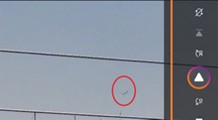 |
| 2 | From Djibouti – 3B-NBZ | Partial / off | 12:31 – 13:08 | It appeared only during take-off, and then intermittently, disappearing and reappearing. Its inbound route to Sana’a was not displayed. The aircraft was documented by field video. | 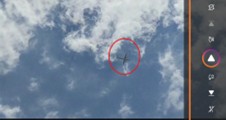 |
| 3 | No ID (-) | Off | 12:50 – 13:58 | An unidentified, untracked aircraft whose landing was concealed through an organised aerial decoy operation involving the United Nations aircraft UNO136H. The unidentified aircraft’s landing and take-off were documented by field video. | 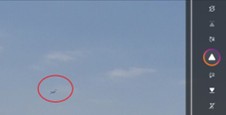 |
- Detailed Chronology of the UN Aerial Decoy Operation
Since July 2025, the teams of the #We_Will_Not_Remain_Silent and #Where_Is_The_Money campaigns, led by Dr. Abdulqader AlKharraz, have conducted daily monitoring and tracking. They publish near-daily updates on movements at Sana’a Airport through Dr. AlKharraz’s page (1). In November 2025, they also published a FraudWiki report on the parallel air channel as a security threat hub and on the exploitation of humanitarian cover at Sana’a Airport (2). One team conducts field observation and monitoring around the airport, while another tracks aviation data through online platforms such as Flightradar24. The teams then cross-check their field observations against the data made available or displayed by those platforms.
On Monday, 24 August 2026, cross-checking ADS-B tracking data against field documentation revealed that United Nations flight UNO136H had been used to provide air cover and as a deceptive decoy to facilitate the landing of the third unidentified aircraft at Sana’a Airport. The detailed chronology of the operation was as follows:
| Time | Details |
| 08:09 | United Nations aircraft UNO136H departed Jordan without a specified destination being listed on flight-tracking platforms (Figure 1). |
| 10:15 | Red Sea route: United Nations aircraft UNO136H flew south over the sea, passing Bab al-Mandeb towards Aden. It became visible to the team on the tracking platform, while its destination remained undisclosed (Figure 2). |
| 11:30 | The ADS-B tracking data for United Nations aircraft UNO136H was suddenly updated to show its declared destination as Aden International Airport (Figure 3). |
| 11:33 | United Nations aircraft UNO136H landed at Aden Airport and remained on the ground for 45 minutes. |
| 12:17 | United Nations aircraft UNO136H departed Aden Airport, with the tracking data showing a return flight to Jordan and an estimated arrival time of 15:24 (Figure 4). |
| 12:20 | Sudden change of route: Rather than taking the standard maritime route on its return journey, United Nations aircraft UNO136H flew inland across Yemen via Lahj, Al-Dhale’e, IBB, Dhamar and Sana’a (Figure 5). This raised suspicions among the field observers that it might land or provide aerial cover.
Previous field observations had recorded aircraft landing at and taking off from Sana’a Airport despite no tracking signal being displayed. This heightened suspicions regarding the aircraft, and the team continued to monitor its route across the governorates listed above. |
| 12:30 | A signal from an aircraft identified as 3B-NBZ suddenly appeared over Sana’a for several minutes before disappearing (Figure 6). Its data indicated that it had arrived from Djibouti without transmitting tracking data during its inbound flight to Sana’a. It was one of the three aircraft documented through field observation. Meanwhile, United Nations aircraft UNO136H continued along its route over Yemen’s inland territory. |
| 12:49 | The signal from aircraft 3B-NBZ reappeared between Dhamar and Ibb while United Nations aircraft UNO136H was directly above Sana’a (Figure 7). |
| 12:50 | Landing of the third unidentified aircraft: Field observers recorded an aircraft with no displayed tracking data landing at Sana’a Airport. They initially believed it was United Nations aircraft UNO136H; however, the tracking platform showed UNO136H continuing to fly over Sana’a without landing (Figure 8). |
| 12:55 | United Nations aircraft UNO136H continued north via Amran (Figure 9), Al-Mahwit (Figure 10) and Hajjah (Figures 11 and 12), before leaving Yemeni airspace towards Jordan. It remained visible on the tracking platform, while aircraft 3B-NBZ continued to appear as it headed south towards Aden. |
| Finding: The incident confirmed that United Nations aircraft UNO136H, which was bound for Jordan, served as a decoy for the landing of the third aircraft observed in the field. That aircraft concealed its signal and had no data displayed on the tracking platform. The incident also confirmed that the route was deliberate and that the United Nations contributed to supporting the Houthi militia by facilitating and attempting to conceal the landing of an unidentified aircraft, creating risks associated with the smuggling of experts, weapons and other items. | |
| # | Images captured from Flightradar24 tracking on 24 August 2026, corresponding to the detailed chronology in the preceding table |
| Figure 1 | 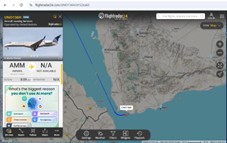 |
| Figure 2 | 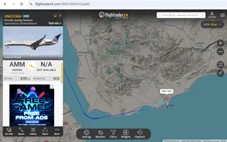 |
| Figure 3 | 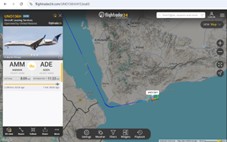 |
| Figure 4 | 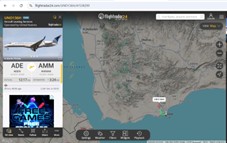 |
| Figure 5 | 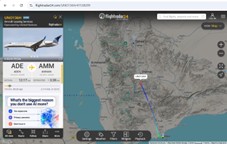 |
| Figure 6 | 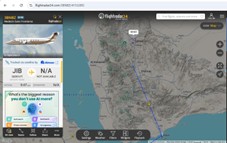 |
| Figure 7 | 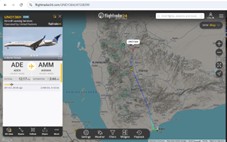 |
| Figure 8 | 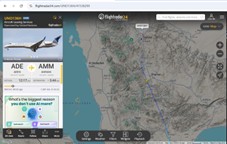 |
| Figure 9 | 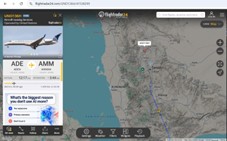 |
| Figure 10 | 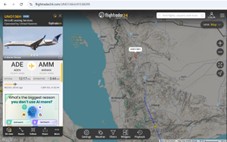 |
| Figure 11 | 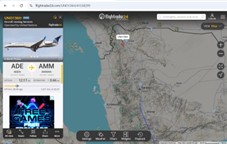 |
| Figure 12 | 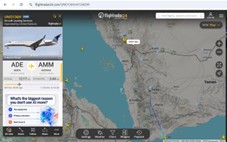 |
- Daily Radar Network Monitoring Updates for Today (August 26, 2026) and Conclusive Implications
As part of the continuous daily field and radar monitoring conducted by our teams via tracking networks, the UN aircraft under callsign (UNO136H) was tracked today, Wednesday, August 26, 2026, on Flightradar24 during its return flight from Aden International Airport heading toward the Jordanian capital, Amman (Image No. 13, captured at 12:41 PM). Comparative navigational analysis of the aircraft’s movement today yielded the following conclusive implications and findings:
- Direct and Safe Navigational Route Behavior Over the Red Sea: Today August 26, 2026, the UN aircraft (UNO136H) was observed taking the standard airway directly over the waters of the Red Sea immediately upon exiting southern Yemeni airspace, without making any navigational deviations or entering the mainland and inland airspace of Yemeni governorates under the control of the Houthi militia.
- Confirmation and Documentation of the Aviation Decoy Hypothesis: The stark contrast and radical change in the path of the exact same aircraft between its flight on August 24 and its flight today, August 26, 2026, conclusively proves the validity of what was documented in the previous sections of this report. It establishes that the UN aircraft’s deep penetration into the mainland on August 24, 2026—passing through the airspace of (Lahj – Al-Dhalea – Ibb – Dhamar – Sana’a – Amran – Al-Mahwit – Hajjah)—was not due to navigational reasons or emergency circumstances. Rather, it was a deliberate aviation decoy and radar cover operation specifically executed to provide air cover for an unidentified phantom/stealth aircraft landing at Sana’a Airport away from tracking systems, even though the maritime route was accessible and safe.
- Impact of Proactive Announcement and Field Vigilance: The fact that the United Nations and the flight operators were alerted and altered the aircraft’s route today to take the direct maritime path immediately following our announcement yesterday, August 25, 2026—where we disclosed the detection of the decoy operation and prepared to publish a detailed report documenting the violation—demonstrates beyond a shadow of a doubt a state of confusion and a rapid attempt to contain a navigational scandal. This underscores the critical role played by our campaign’s field and technological monitoring efforts in uncovering the hidden dynamics of this closed airlift and forcing the involved parties to pull back and take heed. Furthermore, it confirms the hidden role of UN flights in supporting the Houthi militia and facilitating smuggling operations through stealth flight operations.
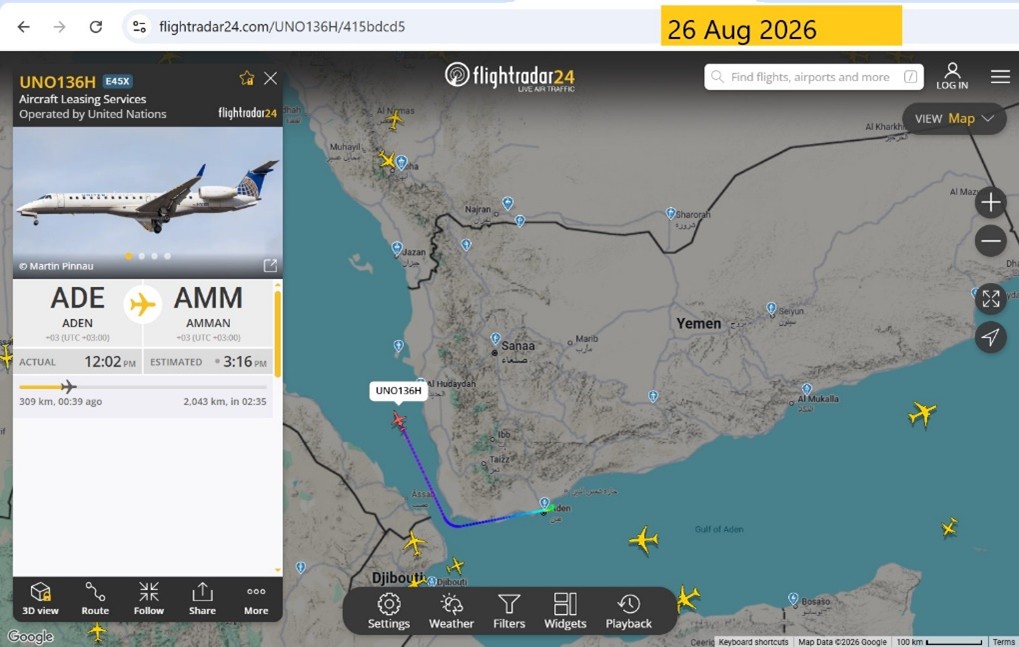
Figure 13: A screenshot captured from the radar website (Flightradar24) showing the UN aircraft (UNO136H) on August 26, 2026, taking the safe maritime route toward Jordan. This confirms what was documented on August 24, 2026, regarding the decoy operation conducted by the aircraft while traveling through the inland airspace over Sana’a.
- Mechanisms and Methods Through Which the United Nations Supports the Houthi Militia
This incident indicates the existence of advanced operational methods that exploit UN immunity and cover to facilitate the militia’s activities beyond international and regional oversight:
- Aerial cover and decoy operations: Official UN flights are routed without justification over Houthi-controlled areas to create observational ambiguity and to confuse tracking and aerial-surveillance systems. This enables unidentified aircraft operating without ADS-B to land and take off under the cover of UN air traffic.
- Manipulation of aviation data: Flight plans and declared destinations are deliberately altered mid-flight—from no destination being specified to Aden being declared—followed by an unscheduled inland route towards Sana’a before the aircraft returns to Jordan. This violates standard aviation-safety protocols and facilitates coordination with the Houthi militia.
- Transponder shutdown: UN acquiescence or implicit coordination permits aircraft departing from regional locations, such as Djibouti, to fly with their transponders switched off. This turns Sana’a Airport into a “black hole” in international aviation oversight.
- Exploitation of humanitarian corridors for logistical purposes: Facilities and agreements granted to UN humanitarian flights are converted into a protective umbrella for the safe passage of flights that are not inspected or screened by the internationally recognised government or the coalition.
5.Exploitation of Humanitarian Cover and the Resulting Security and Military Risk Matrix
Facilitating the passage of unidentified aircraft and movements at Sana’a Airport under the banner of “UN humanitarian operations” shields them from rigorous security screening and inspection. The following matrix sets out the direct risks associated with the suspicious aviation activity:
| Risk category | Details and threat mechanism | Severity |
| Smuggling of leaders and experts | Transporting experts from Iran’s Islamic Revolutionary Guard Corps and Hezbollah, or internationally wanted Houthi leaders, without undergoing any security-screening procedures. | Critical |
| Transfer of weapons and sensitive equipment | Smuggling high-technology parts and components, including drone-guidance systems, ballistic-missile parts, and high-value, lightweight encrypted communications equipment. | Critical |
| Movement of illicit funds | Moving shipments of foreign currency or valuable materials into or out of the country to sustain the Houthi militia’s financial lifelines and circumvent international financial sanctions. | High |
| Undermining the international oversight system | Creating a precedent in which UN flights become a means of deception, undermining their credibility and the enforcement mechanisms of UN resolutions, including Resolution 2216. | High |
6.Strategic Recommendations
- Re-regulate flights to and from Sana’a Airport: Flights should balance humanitarian necessity with the prevention of abuse, and should be limited to no more than eight per month, including one cargo aircraft when required to transport emergency medical supplies. All aircraft should be inspected, screened and monitored on both outbound and return legs at Aden Airport. As an initial measure, all flights should be fully suspended for one month while revised control procedures are established.
- Enforce rigorous inspection and transparency: Require all UN aircraft and all aircraft bound for Sana’a Airport to keep their ADS-B systems active throughout the flight, with non-compliance resulting in the cancellation of flight permits.
- Scrutinise flight plans: Reject sudden rerouting within Yemeni territory by transit flights or flights arriving from Aden or Jordan unless compelling reasons are provided and prior approval has been obtained.
- Submit a formal note of protest: Refer this report, together with its field and ADS-B documentation, to the Truce Violations Cell and the Joint Committee, and request an official explanation from the United Nations regarding the circumstances of flight UNO136H and the use of the Sana’a route as a decoy.
- Strengthen ground and radar monitoring: Develop field and technical surveillance capabilities that link ground movements with air traffic, thereby reducing the gaps exploited by covert flights.
References
- (1) Dr. Abdulqader AlKharraz’s accounts on Facebook and X (formerly Twitter)
- (2) Report: “The Parallel Air Channel: A Security Threat Hub and the Exploitation of Humanitarian Cover,” FraudWiki, November 2025
Reading Link:
Final Report - Documentation of the UN Aerial Decoy Operation - 26 August 2026
Download Link:
https://drive.google.com/file/d/1dGeieh06Q3Dn3syI_nY1pxMobhRh4FQn/view?usp=drive_link

