
Report – First Part
Power and camouflage in the Houthi Security and Intelligence Service (HSIS)
“Structural and Strategic Analysis of Roles and Threats”
FraudWiki, November 2024
Introduction
In its first part, this report aims to provide a perception and analysis of the security and intelligence Service of the Houthi militia based on information and documents collected over several years from reliable sources dedicated to serving Yemen. The data submitted until the beginning of 2023 was audited and also tracked via open sources on websites and campaign publications such as (#لن_نصمت #وين_الفلوس), as well as reviewing previous reports of the FraudWiki platform to the subject ensuring accuracy and reliability in the context of the complex situation facing the country.
The Houthi militia is one of the main armed factions in Yemen, having established its own security and intelligence apparatus as a means of consolidating its power and asserting control over the areas it governs and after carrying out numerous information-gathering operations and surveys to identify loyalists and opponents. This requires understanding the structure and operational modalities of this service and is critical to assessing the threats posed by militias to local, regional, and international security.
It is important to note that the Houthi militia often rotates personnel in key positions to maintain operational security and camouflage. This practice is essential to prevent the disclosure of its strategies and reduce the risk of infiltration or intelligence gathering by rival factions or external entities. By systematically changing the roles of key individuals, the militia creates an impression of stability and authority while ensuring that sensitive information remains protected., in addition to camouflage to ensure that individuals or transnational companies affiliated with it that engage in illegal activities such as arms smuggling and recruitment in international wars are not tracked.
This report will shed light on the names and roles of some individuals within the Houthi security and intelligence apparatus, and provide insight into their backgrounds, relationships, and operational activities. Each section will address how these individuals contribute to the militia’s overall strategy, as well as the repercussions of their actions on the security landscape in Yemen and beyond and the issues of forced abductions, torture, and killings.
1. Overview of the Houthi Security and Intelligence Service
The Houthi militia established its own security and intelligence apparatus in 2016, in response to the escalating conflict and the need for a coherent security apparatus. This initiative marked an important step in the militia’s efforts to consolidate its authority and assert control over the territory it occupies in Yemen. This represents an important step in its efforts to consolidate its authority and enhance its operational capabilities. This agency was created in response to Yemen’s increasingly complex and volatile political landscape.
1.1.Initial processes and structure
Initially, the Houthi Security and Intelligence Service HSIS operated under a veil of secrecy. The militia issued decisions through the so-called Revolutionary Committee, which was formed to centralize power and streamline decision-making processes. This approach allowed the Houthi leadership to maintain tight control over intelligence operations while minimizing the risk of exposure to external and internal adversaries.
The Houthi security and intelligence apparatus is a critical element of the militia’s strategy to consolidate control and overcome the challenges posed by a multifaceted conflict. Through a combination of secrecy, personnel rotation, and strategic alliances, the militia aims to enhance its operational capabilities while managing perceptions both domestically and internationally. Understanding the dynamics within this apparatus, particularly the roles of key figures and the creation of companies that follow the militia abroad through individuals affiliated with the militia and the security apparatus and their connections.Centers or councils established at home such as the Supreme Council for Humanitarian Affairs (SCAMCHA) or the Humanitarian Operations Coordination Center (HOCC), as well as their affiliations with organizations such as the Arab Organization for Human Rights (ARWA) or Ensan Organization, are essential to understanding the broader implications of the Houthi militia’s actions in Yemen and beyond.
1.2. Unification of security services
In 2019, the militia took another step by merging all existing security agencies, such as political security and national security, under the authority of the NISS. With these other agencies remaining in their structure and functions but under the authority of the Security and Intelligence Service and people being transferred from one location to another within this structure, this unification reflects the militia’s strategic approach to strengthening its control over the security scene in Yemen. The analysis process ofmerging different security functions into one agency illustrates several implications:
- Central Command Structure: By integrating the various security agencies, the Houthi militia has created a centralized command structure that allows for more effective decision-making and resource allocation. This simplification enables the militia to respond quickly to security threats and coordinate its operations more efficiently.
- Enhanced surveillance and intelligence capabilities: Standardization facilitates a comprehensive approach to intelligence gathering and surveillance. With the consolidation of multiple security functions, the militia can more effectively monitor potential threats, including dissent among the population and the activities of rival factions.
- Improved operational coordination: The concentration of security operations promotes better coordination between different units. This integration ensures rapid intelligence exchange and action, thereby enhancing the overall effectiveness of security measures.
- Strategic resource management: Integration allows for a more strategic allocation of resources, including personnel, technology, and finance. The militia can deploy its forces based on the threats assessed, increasing its operational effectiveness.
1.3. Modes of operation
The Houthi security and intelligence service uses different operational methods to achieve its objectives , and by looking at this and anticipating the methods, we find the following:
- Intelligence gathering: Using both human and signal intelligence, the device collects information on potential threats, including monitoring communications and conducting surveillance on individuals and groups.
- Surveillance and monitoring: The service has developed extensive surveillance capabilities to monitor dissent, using technology and human resources to track activities and individuals deemed a threat.
- Interrogation and coercion: The militia is notorious for using aggressive interrogation tactics and intimidation tactics to extract information from detainees, reflecting its ruthless approach to maintaining control.
- Coordination with other actors: The Houthi militia often cooperates with other organizations and entities to enhance its intelligence capabilities and expand its influence, both domestically and internationally.
The structural analysis and operations of the Houthi security and intelligence service illustrates a sophisticated and strategic approach to governance and security. By uniting the various security services and empowering key individuals in their ranks, the militia is consolidating its control over the territory it occupies. Understanding the dynamics within this service, including the roles and operational modalities of key figures, is essential to understanding the broader implications of the Houthi militia’s actions in Yemen and the surrounding region.
2. Organizational Structure of the Houthi Security and Intelligence Service
The Houthi security and intelligence apparatus is organized into a hierarchical structure that allows for the efficient management and coordination of various security operations. This structure aims to facilitate both internal and external intelligence activities, and to ensure that the militia is able to respond effectively to threats and maintain control over the territory it occupies. Through the documents we obtained, we have tried to develop a vision of the main organizational structure of the Authority, both at the level of leadership, agents and consultants (Document 1), as well as to develop a vision for the departments, departments (Document 2) and divisions of the Authority.

| Document 1: Designing the command structure in the security and intelligence apparatus of the Houthi militia (through sorting documents and data) |
| Document 2: Designing a structure for the departments in the security and intelligence apparatus of the Houthi militia (by sorting documents and data) |
2.1. The main components of the structure
- Leadership Team:
At the top of the hierarchy is a leadership team consisting of senior officials responsible for overall strategic decisions. Included in the agency’s head, deputy, Undersecretaries and consultants, this team usually includes individuals with strong loyalties and ties to the movement’s leader, as well as military backgrounds and experience in intelligence operations.
- Operational Divisions:
The Security and Intelligence Service is divided into several operational sections, each of which is entrusted with specific responsibilities related to intelligence gathering, surveillance, enforcement, foreign operations, espionage, and political parties and organizations, etc. We have classified the first part of the main departments into 20 departments initially (see document 2) and come under them small departments and then divisions, and the main sections include the following:
- Internal intelligence operations: Monitor internal threats, including opposition and potential opposition activities within Houthi-controlled territory.
- Foreign intelligence operations: focuses on gathering information on foreign adversaries and international developments that may affect the strategic interests of the militia. In addition to working to create commercial entities that constitute a cover for the actions of the outlaw militia.
- Counterintelligence: Engaging in measures to prevent infiltration and espionage by rival factions or foreign intelligence agencies.
- Surveillance operations: Conduct surveillance of key individuals, opposition movements, and other potential threats to Houthi control.
- Political Parties and Organizations: Collecting information about the political activities of international and local parties, organizations and organizations, including their plans, strategies, and orientations. Monitoring activities and reporting to act according to the analysis of information, and this may include recommending abductions of individuals in parties, organizations, independent activists or the media.
2.2. Main Persons
- AbdulHakim Hashem Ali Al-Khiwani

- Head of the Security and Intelligence Service of the Houthi militia with the rank of major general, and he is one of the leaders who are very loyal to the leader of the Houthi group
- His first official appearance appeared through a decision of the militia’s Revolutionary Committee No. 207 dated July 2016, where he was appointed as Deputy Minister of Interior (Document 3), and this is the same time that the Security and Intelligence Service was secretly formed and he was the head of the service from that secret period until its announcement in 2019.
- It seems that the appointment to the Ministry of Interior was a cover operation carried out by the militia so that al-Khaiwani could form the apparatus and select individuals loyal to the militia, whether in the Ministry of Interior or other agencies.

| Document 3: Decision to appoint Abdulhakim Al-Khaiwani as Deputy Minister of Interior by the Houthi Revolutionary Committee in 2016 |
- Abdulqader Ahmed Qasim Al-Shami

- AbdulQader Al-Shami was appointed as deputy head of the agency and the rank of major general in 2016 secretly and then appeared publicly with the announcement of the formation of the agency in 2019, and there is recent information that he was transferred to another job or assigned to a task in addition to his work
- AbdulQader Al-Shami is believed to be related to the entity formed by the Houthi militia in February 2024 and named the Humanitarian Operations Coordination Center (HOCC) (1), along with Ahmed Hamed, director of the office of Mahdi Al-Mashat, who is named head of the militia council, and HOCC is the responsible entity when ships are threatened in the Red Sea.
- There are many relatives of AbdulQader Al-Shami who work in international organizations, which may have a role in recruiting them to serve the militia, whether obtaining information or by directing funds or working to beautify the militia in the West, including Angham Al-Shami, the liaison officer of the International Monetary Fund in Washington, as well as Ahmed Al-Shami, director of the Arab Organization for Human Rights, which is one of the hands of the Houthis in the West and its office in America and in partnership with Mohammed Reda Al-Wazir And those whom we mentioned in the reports of the secret organization of the Houthis in international organizations and funds (2 and 3) and how it also made it easy for Ahmed Al-Shami to appear as a neutral person from institutions such as DeepRoot for Raafat Al-Akhali as well as the Hikma program for Abeer Al-Mutawakel, wife of Al-Akhali
- Ahmed Muhammad Yahya Hamed (Abu Mahfouz):

- Ahmed Hamed is the director of the office of Mahdi al-Mashat, head of the Houthi militia’s political council since they took control of Sana’a until now.
- Ahmed Hamed first appeared in an official decision of the militia in 2016 as a member of the Media Committee of the Political Council by Decree No. 17 of 2016 (Document 4).
- He is considered the de facto ruler of the militia and the representative of the leader of the Houthi group, and he is the main supervisor of all councils and committees formed by the Houthis, and he is considered the main supervisor of the Supreme Council for Humanitarian Relief (SCAMCHA) of the Houthi militia, which was recently abolished and the international cooperation sector was included in the Ministry of Foreign Affairs (Document 5) and this aims to obliterate all corruption and operations in which (SCAMCHA) participated during the last period
- He is also the first official, according to various sources, for the Humanitarian Operations Coordination Center (HOCC) with AbdulQader Al-Shami.
The Humanitarian Operations Coordination Center (HOCC) is responsible for threatening ships in the Red Sea, and it also coordinates with maritime companies that seem to take royalties to ensure that they are not hit even if they have nothing to do with what they claim, and as we mentioned in the report of the sinking of the #الباخرة_روبيمار in April 2024 (4) that the Houthi militia has deals with international mafias, whether to dump hazardous waste at sea or sink ships that are expirible, and here is another deal related to insurance, so The militia created this entity or center and made an official formula for it to be able to communicate with companies and organizations and make deals under its cover.
Among the tasks of this center (HOCC) is “to abide by Islamic teachings and comply with international humanitarian law and other relevant international laws and conventions in a manner that does not conflict with the interests of the Republic of Yemen or harm them.” …. Is this true and did the militia adhere to this statement?

| Document 4: Decision to appoint Ahmed Hamed as a member of the media committee of the Houthi militia in 2016 |
| Document 5: Circular canceling (SCAMCHA) from the Ministry of Foreign Affairs of the Houthi militia to international organizations in Yemen in October 2024 |
- AbdulSalam Salah Ahmed Fleita

- AbdulSalam Salah Ahmed Fleita is an important player in the militia’s external operations. He is the official spokesman of the militia abroad and their representative in international negotiations and meetings (Document 6)
- While his civil name is registered, he uses the code name Mohamed AbdulSalam for operational security. (Document 7) It also coordinates the supply of funds or weapons to the militia and smuggles it through multiple networks and companies under the cover of commercial, investment and transport companies, assisted in organizing by Ahmed Shami and AbdulMalik Al-Ajri.
- His responsibilities include:
- Coordination with key figures: Close cooperation with Hassan al-Kahlani and Abdulwahid Abu Ras (external operations of the Security and Intelligence Service) as well as Ahmed al-Shami to align Houthi interests abroad. This cooperation enhances the militia’s ability to manage its international relations and operational objectives.
- Intelligence and logistics: Assist in the logistical planning of operations that may take place outside Yemen, and ensure the smooth flow of resources and information to support Houthi objectives.

| Document 7: Civil Registry of AbdulSalam Salah Ahmed Fleita |
| Document 6: Decision to appoint AbdulSalam Fleita as head of delegation at the 2018 Geneva meetings |
- Abdulwahid Naji Mohammad Abu Ras

- One of the Houthi leaders who do not appear much and his work is surrounded by high secrecy, and since the beginning of the formation of the Security and Intelligence Service in 2016 he was appointed Undersecretary for Foreign Operations Affairs
- Abu Ras, who is in charge of external operations, plays a crucial role in coordinating the Houthi militia’s activities beyond its borders. His responsibilities may include:
- Intelligence gathering: Gather information on foreign adversaries and potential allies to inform Houthi strategies.
- Cross-border operations: Managing operations that extend to neighboring areas, particularly in the Horn of Africa, where militias are known to engage in arms smuggling and other illicit activities. Such as drug trafficking and even secret coordination operations to dismantle the diplomatic front of the Yemeni embassies abroad affiliated with the legitimacy
- Networking: Establish contacts with international actors that may support the Houthi agenda or facilitate operational capabilities.
- Under the management of Aburas comes the Department of Foreign Operations, which is run by Hassan al-Kahlani, and it is likely that al-Kahlani became an undersecretary instead of Aburas to devote Abu Ras to organizing operations in the Horn of Africa.
- Hassan Ahmed Hassan Al-Kehlani

- As overseeing external operations, Kahlani’s position is vital to managing the militia’s international engagements. Currently, it is likely that he became an undersecretary of the Security and Intelligence Service for foreign operations instead of Abdul Wahid Aburas, and in 2019 he was awarded by the militia the Order of Courage by Resolution No. 174 (Document 8) with Hassan Al-Marrani, one of the undersecretaries of the Security and Intelligence Service.
- His involvement in external operations includes:
- Arms procurement: Coordinate the acquisition of weapons and military supplies through illicit networks.
- Drug trafficking: Oversee links to drug smuggling operations that may finance Houthi military activities.
- Operational planning: Develop strategies for carrying out operations abroad, ensuring that they align with the militia’s broader military and political objectives.
- Coordination with individuals in international organizations and funds: International coordination processes are based on external operations through individuals within these organizations to cover the crimes of the militia or facilitate the arrival of funds or provide them with information and beautify the militia, and as we mentioned in the reports of the secret organization of the Houthis in international organizations and funds there are members of relatives of Houthi militia leaders who occupy senior positions and are relied upon, including Fouad Ali Al-Kahlani (previous reference 2) He is the Senior Consultant of the International Monetary Fund and is a relative of Hassan Al-Kahlani and also Fouad’S father is one of the militia leaders and the assistant of the Houthi defense Minister
- Hassan Al-Kahlani, as we mentioned, is likely to be currently an agent of the agency for external operations and was previously the director of the agency’s branch at Sana’a airport, and also in 2020 he was appointed the staff of the third region of the militia, and a lot of information indicates that he is in Iran, in addition to that he attended with AbdulSalam Fleita as well as Abdul Malik Al-Ajri one of the rounds of negotiations in Riyadh. Recently, Al-Kahlani was placed on the US Treasury sanctions list (5)

| Document 8: Resolution to award Hassan Al-Kahlani and Al-Hassan Al-Marani the Order of Al-Shajaa from the Houthi militia |
- Amer Ali Amer Al-Marani and his brother Al-Hassan and Mutlaq Al-Marani

When the political and national security services were merged with the HSIS, some leaders changed in their positions, but the structure of the structure seems to have remained the same, and people from Military Intelligence were transferred to the service, so through the documents and data that were available, their transfers can be tracked from one location to another, such as Amer Al-Marrani.
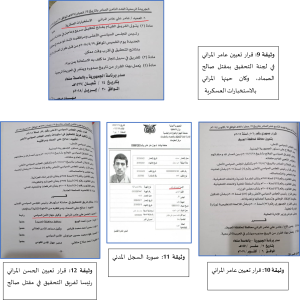
- Amer Al-Marani was in Military Intelligence and was assigned as part of the team to investigate the killing of Saleh Al-Samad, head of the political council of the Houthi militia in April 2018 (Document 9)
- Then he was appointed in October 2019 as governor of Al-Jawf (Document 10), and in April 2021, another governor of Al-Jawf was appointed in his place and he was appointed Minister of Transport, and currently he was transferred to a new position that appears within the agency, which is a major general within the militia.
- His brother Al-Hassan Ali Amer Al-Marani (Civil Registry Document 11), It was falsely rumored that he was killed in Al-Jawf and who was appointed in 2018 as an undersecretary of the agency for internal security affairs, and before that he was appointed by the militia as an undersecretary for political security, which was merged with the Security and Intelligence Service, and he was the head of the investigation team into the killing of Al-Samad in April 2018 ( Document 12), and he was also given the medal of the Houthi militia in September 2019 with other people ( previous document 8), including Hassan Ali Hassan Al-Kahlani
- His brother Mutlaq Amer Al-Marrani is likely to be currently an agent of the Internal Security Agency for Internal Security Affairs instead of his brother Al-Hassan, and Mutlaq is included in the Security Council sanctions list since September 2022 (6)

| Document 9: The decision to appoint Amer Al-Marrani to the investigation committee into the killing of Saleh Al-Samad, then Al-Marrani was in Military Intelligence |
| Document 12: Decision to appoint Hassan Al-Marrani as head of the investigation team into the killing of Saleh Al-Samad in 2018 |
| Document 11: A copy of the civil registry of Hassan Marrani |
| Document 10: Decision to appoint Amer Al-Marrani as Governor of Al-Jouf in 2019 |
- Qasim Ahmed Qasim al-Hamran (Abu Ahmed)

- Qassem Ahmed Qassem Al-Hamran was in the Security and Intelligence Service and is still hidden, and the militia appointed him in July 2019 as Deputy Minister of Local Administration (Document 13), and he is one of the most loyal leaders of the leader of the Houthi group and is considered one of the first generation,
- Qassim al-Hamran was responsible for the secret field surveys of the Houthis in a number of governorates in 2013, which were aimed at collecting information on loyalists and opponents of the Houthi group, and his name appeared in the survey files for Al-Bayda governorate, and it is clear according to the data and structure in force in some documents that Al-Hamran was a supervisor and governor of Al-Bayda secretly in 2013. ( Documents 14 and 15)
- Sana’a University gave Qasim Ahmed Al-Hamran a doctorate degree in February 2022 (7) This also shows the militia’s targeting and distortion of education in Yemen and the fact that its leaders obtain higher degrees that they do not deserve.
- Relatives of Al-Hamran and his nephews as well, including 7 who are present in the HSIS and have positions within the departments and departments of counter-terrorism, investigations, the economic department and ports (such as AbdulHakim Al-Hamran, Ibrahim Al-Hamran, AbdulRahim Al-Hamran, Taha Al-Hamran, AbdulMalik Al-Hamran) and there is the director of the HSIS’s branch in Saada, Hassan AbdulRahim Qasim Al-Hamran.
| Document 13: Decision to Appoint Qassim Ahmed Qassim Al-Hamran as Deputy Minister of Local Administration of the Houthi Militia 2019 |
| Document 14: From the 2013 Houthi surveys file, Qassim Ahmed Qasim Al-Hamran, supervisor of Al-Bayda Governorate |
| Document 15: From the 2013 Houthi Surveys File The Secret Work Structure of the Houthi Militia in Al-Bayda Governorate |
- Qasim Qasim Ahsan Ali Al-Hamran( Abu Kawthar)

- Qasim Qasim Ahsan Ali Al-Hamran is a relative of Qasim Ahmed Al-Hamran, and is currently the commander of the militia’s support and support brigades, which were formed in 2020 and Al-Hamran appeared in 2022 as the commander of these battalions and was given the rank of major general.(8),
- The Support and Support Brigades are a jihadist formation of the militia and are built as a reserve force entrusted with combat missions on fronts that are not limited in geographical scope. It has adopted a slogan for itself in which symbols of sectarian ideology are sanctified, adapted from the slogans of entities affiliated with Iran and groups loyal to it. Its formation is part of the formation of other ideological forces established by the militia over the past years as parallel forces under its kinetic composition and linked to its leader.
- Al-Hamran moved between several organizational and leadership positions, from deputy head of the militia’s executive office until the end of 2019, then supervisor and deputy minister of education for the militia in 2021, and then appeared in 2022 as commander of the militia’s support and support battalions.
- Also, Sana’a University gave Qasim Qasim Al-Hamran a doctorate degree in December 2023 (9)
- Ahmed AbdulAli Ahmed Shami

- Ahmed Al-Shami holds American citizenship, and as soon as the Houthi militia took control, he returned from America and was appointed in 2016 as a member of the Economic Committee of the Houthi militia by Resolution No. 17 (document 16). He was also considered one of the official spokespersons of the militia in many international television interviews (10)
- He is considered the special commercial coordinator for the business and companies that belong to the militia and AbdulSalam Fleita, arranging for them, coordinating for their registration in countries outside Yemen, coordinating with the individuals who own these companies, which are engaged in illegal activities such as smuggling weapons and many equipment to the Houthi militia, in addition to working on the control of the militia’s subsidiaries over many commercial sectors such as medicines, spare parts, etc., as he holds American citizenship, he moves to Europe from Britain, Switzerland and Germany to America and even the east Asia, also used as a cover for the American Human Rights Center, which is affiliated with him and Mohamed Reda al-Wazir, the “Arab Organization for Human Rights (ARWA)” registered in America. (11)
- Through tracking and as we mentioned in the reports of the secret organization of the Houthis in international organizations and funds (previous reference 2 and 3), Ahmed Al-Shami shows himself as a neutral person and his cooperation in that institutions work with organizations (such as DeepRoot , Hikma Program for Raafat Al-Akhali and Abeer Al-Mutawakel) and participates and attends international meetings as the director of the Arab Organization for Human Rights (ARWA) (12) In doing so, he also works close to the UN envoy to Yemen. This, in turn, plays an influential role in directing the policies and decisions of the UN envoy in favor of the Houthi militia, and it is possible to mention the example of the pressure exerted by the UN envoy to stop the procedures of the Central Bank in Aden in July 2024.

| Document 16: Decision to appoint Ahmed Abdulali Ahmed Al-Shami to the Economic Committee of the Houthi militia 2016 |
The organizational structure of the Houthi Security and Intelligence Service (HSIS) is designed to support a range of operations, both domestically and internationally. By appointing key figures such as AbdulWahid Naji Muhammad Abu Ras, Hassan al-Kahlani, AbdulSalam Salah Ahmed Fleita, and Ahmed al-Shami to critical roles, the militia ensures its ability to effectively gather intelligence, manage security threats, and conduct operations that advance its strategic objectives. Understanding this structure is essential to analysing the militia’s capabilities and continued influence in the region, particularly in the context of Creating multilateral companies engaged in arms smuggling and illicit activities that undermine regional stability. In addition to influences at various levels in the corridors of the United Nations and its organizations.
Since the Houthi militia entered Sana’a in 2015 and through its Revolutionary Committee, it has worked to infiltrate the various security and military agencies and through recommendations from the leaders of the Houthi security and intelligence service, many individuals in these bodies have received rapid promotions, illegal or not based on hierarchy and work, which reflects the militia’s focus on loyalty and operational effectiveness. These promotions are crucial to maintaining morale and ensuring that loyal individuals and leadersBy directing the security efforts of the militia. The decisions for promotion included hundreds of personalities (attached a number of documents for the decisions of promotions as examples (documents 17 and 18) and we mention the main figures who were promoted and introduced to the Security and Intelligence Service and occupy key positions within it as undersecretaries of the service as follows:
- Tariq Mohammed Ahmed Yahya Al-Hadi: Al-Hadi was promoted to the rank of major general in 2017. (Document 19) His rise in ranks and positions indicates the extent of loyalty to the militia and its importance within the militia’s military structure..
- Mohammed Abbas Abdullah Mohammed Amer: Amer has been promoted to the rank of brigadier general and has maintained this rank since 2017. (Document 19), he is currently the agency’s undersecretary for financial and administrative affairs, and his firm position reflects his established role within the militia, indicating that he has significant responsibilities in overseeing various operations.

| Documents 17 and 18: Models of Military Promotion Decisions from the Revolutionary Committee for Houthi Militia Loyalists 2016 |
| Document 19: Promotion decision for Mohammed Abbas Amer and Tariq Al-Hadi from the Houthi militia 2017 |
4. Kidnapping and coercive tactics
The Houthi militia has gained notoriety for using kidnapping and coercion tactics as tools of repression and control within the territory it occupies. These actions are part of a broader strategy to stamp out dissent, intimidate potential dissent, and instill fear among the population. The militia’s tactics are emblematic of its approach to governing in a conflict-torn environment where any opposition or criticism is met with swift and often brutal reprisals.
4.1. Abduction of journalists, civil society activists and employees of organizations
The militia has been involved in numerous kidnappings targeting journalists, activists, civil society leaders and even employees of organizations. These individuals are often seen as posing a threat to the Houthi narrative or potential sources of information that could undermine the militia’s authority or affect its interests.
- Media targeting: Journalists are particularly vulnerable to kidnapping as the Houthi militia seeks to suppress independent reporting and control the flow of information. By silencing journalists, the militia can shape public perception and limit the exposure of its actions, including human rights violations and abuses. Numerous reports have emerged detailing the arrest of journalists who have written critical reports on Houthi activities, often leading to their detention under harsh conditions.
- Activists and civil society leaders: The militia also targets activists who participate in peaceful protests, human rights advocacy, or celebrations of the proclamation of the republic. Many of these individuals are abducted during demonstrations or raids on their homes, with the intention of silencing voices challenging Houthi authority. The threat of violence against these individuals serves as a deterrent to others who may consider speaking out against the militia. One of the most prominent examples is the kidnapping of several people last September while trying to celebrate the September 26 revolution.
- Employees of international and local organizations: The militia also targeted the employees of local as well as international organizations operating in the areas under its control, and the fact that these kidnappings are not new, but occurred from the end of the year 2020 in light of the silence applied by the organizations whose employees were kidnapped, and the intensity of these kidnappings increased at the end of 2023 as well as in the current year 2024, which led to the exposure of these kidnappings to the world and also began to show the complaint of international organizations about these methods despite their silence about them at the beginning, and this indicates To identify these organizations with what the militia has been doing for years and to remain silent about it, and this in turn encouraged the Houthi militia to practice kidnapping more
4.2. The case of Hisham Al-Hakimi as a model
One of the most well-known cases that exemplify the Houthi militia’s brutal tactics is that of Hisham al-Hakimi. His story highlights the extreme measures the militia is willing to take against perceived enemies:
- Arrest and detention: Houthi security and intelligence forces arrested Hisham al-Hakimi, for reasons unknown at first, but with time information began to emerge stating that al-Hakimi opposes many corruption cases within the organization in which he works, which is Save the Children , and his criticism of the organization’s way of dealing with the militia and the facilities provided to the militia at the expense of needy families, and according to our sources, the director of the organization, called (Rama Hansra), is the one who reported him to the Houthi Security and Intelligence Service.(13) of the Child’s Rule His arrest was not an isolated incident, but part of a systematic crackdown on dissenting voices within organizations.
- Torture and ill-treatment: During his detention, al-Hakimi was subjected to severe torture and inhuman treatment. Reports indicate that he was physically abused, psychologically tortured and other ill-treated designed to extract confessions or intimidate him to silence him. The brutality of his treatment underscores the militia’s disregard for human rights and the rule of law.
- Extrajudicial killings: Tragically, al-Hakimi’s ordeal culminated in his death in custody (14) and is a stark reminder of the dangers faced by those who oppose the Houthi militia. This incident drew significant international condemnation and highlighted the need for accountability for such violations.
4.3. Coercive tactics beyond kidnapping
In addition to abduction, the Houthi militia uses a variety of coercive tactics to maintain control over the population, including:
- Intimidation: The militia uses threats and intimidation as tools to deter dissent. Individuals who express opposition to Houthi policies or actions often face harassment, threats of violence, or even kidnapping. This climate of fear stifles political opposition and suppresses civil society participation.
- Targeting families: The militia not only targets individuals, but often expands its coercive tactics to include their families. Arresting or harassing a family member can act as a powerful deterrent to others, forcing them to remain silent out of fear for their loved ones.
- Public trials and confessions: The Houthi militia is known to hold public trials of detainees, using these events as propaganda tools. Coerced confessions are often presented to legitimize the militia’s actions and portray opponents as criminals or traitors.
- Use of informants: The militia employs a network of informants to monitor activities within communities. This surveillance creates a culture of mistrust among citizens, as individuals fear reporting their conversations and actions to the authorities.
The Houthi militia’s tactics of kidnapping and coercion illustrate a systematic approach to maintaining control and suppressing opponents and critics in Yemen. By targeting journalists, activists, and civil society leaders and employees of organizations, the militia seeks to eliminate any opposition, expose its corruption, or attempt to curb such corruption in relation to international funding.and instilled a climate of fear. Hisham al-Hakimi’s case serves as a chilling reminder of the extreme measures the militia is willing to use to silence critics and assert its dominance. Understanding these tactics is critical to understanding the broader implications of the Houthi militia’s actions on human rights and political freedoms in Yemen.
5. Cover companies and arms smuggling
The Houthi militia, through the HSIS, has established a network of companies under the cover of secrecy and camouflage that operate in sectors seen as legitimate, such as spare parts, cosmetics imports, general trade, investment, transportation, and tourism. However, these businesses are often used as fronts for arms smuggling and other illicit activities, allowing the militia to generate revenue while concealing its true operations. This strategy highlights the militia’s adaptability and ability to exploit existing economic frameworks to support its military objectives.
5.1. Establishment of coverage companies
The militia’s approach involves the creation of various companies ostensibly engaged in legitimate business activities. These companies are often strategically designed to deflect scrutiny from authorities, international organizations , and sanctions committees. The main characteristics of such coverage companies include:
- Legitimate façade: By operating in sectors such as cosmetics, textiles, general trading, tourism, and transportation, these companies appear legit on the surface. This interface allows the militia to conduct business without actual oversight, thereby facilitating its operations without major outside interference.
- Registration outside Yemen: Many of these companies are registered outside Yemen, especially in the Sultanate of Oman. This practice serves multiple purposes:
- Legal Shield: Registering companies abroad provides a kind of legal protection and complicates the ability of international authorities to track and prosecute illegal activities.
- Evasion of sanctions: By acting outside the jurisdiction of Yemeni law, the militia can circumvent sanctions against individuals and organizations associated with its activities.
- Use of different names: Companies often operate under different names and are occasionally changed to camouflage and ensure dispersion of follow-up and monitoring, further obscuring their true nature. While they may present themselves as separate entities , many are owned by the same individuals or connected through complex networks , allowing for seamless coordination between them.
5.2. Examples of some of the companies that have been monitored:
There are, of course, several companies formed by the militia and through the Security and Intelligence Service and in coordination with Ahmed Shami, the militia’s foreign trade coordinator, in order to serve its goals, whether controlling trade in general and oil and gas trade in particular, in addition to using these companies in arms smuggling operations and naming some of them under companies importing cosmetics, spare parts, transportation and general trade. Companies outside Yemen, especially in the Sultanate of Oman and in the Salalah region, are also registered under a new name, and it may be the same name as the owner of the company in Sana’a with the partnership of others or in the name of a new owner who is coordinated with him, who is mainly a loyalist of the militia or worked with them in the security and military services.
5.2.1. Mohammed Saleh Al-Shami Import Company
- The company was registered in Sana’a in 2020 in the name of Mohammed Saleh Al-Shami and under the activity of importing accessories, cosmetics, cars and their spare parts (document 20)
- Registration is carried out for companies outside Yemen and in particular in the Sultanate of Oman under another name and with the same owner who owns the company in Sana’a with the partnership of others, where Muhammad Saleh Al-Shami established another company (Sky Line for Transport and Business) in the Sultanate of Oman in Salalah with a 1395058 registration number and was registered in 2021 and in partnership with his brother AbdulHakim and another person. (Document 21) Of course, the company, according to its tracking, is engaged in several activities registered in its commercial register (Document 22), and it is also clear that the company’s register in the Sultanate of Oman has not been renewed, as it ended in August 2024, and this indicates that the militia and its partners may work as a new camouflage for another company under another name to avoid follow-up and accountability.
Mohammed Saleh Mohammed Al-Shami is one of the prominent individuals associated with this network of covered companies. His role in this business is important for several reasons:
- Ownership and management: Al-Shami co-owns and manages several companies, providing the militia with a vital operational base. Its connections and knowledge of business operations facilitate the militia’s ability to engage in multiple deals while maintaining a veneer of legitimacy.
- Network expansion: The use of al-Shami and others like him allows the militia to expand its business network, establishing contacts with suppliers, customers, and international markets. This network is crucial for the militia to acquire weapons and other materials for its operations.

| Document 20: Registration of Mohammed Saleh Al-Shami Company in Yemen 2020 |
| Document 21: Registration of Mohammed Saleh Al Shami Company in the Sultanate of Oman in 2021 under the name of Sky Line for Transport and Works |
| Document 22: Sky Line Company data of Mohammed Saleh Al-Shami in the Sultanate of Oman (the commercial registration that expired in August 2024 was not renewed) |
5.2.2. Al-Jabri General Trading and Investment Company (Abdulwali Abdo Hassan Al-Jabri) Arms deals and recruitment operations
The Houthi militia is also involved in arms deals and recruitment operations that advance its military objectives. This aspect of the militia’s operations highlights its reliance on local and international networks to secure the weapons and personnel needed for its ongoing conflicts.

- Background:
- Abdulwali Abdo Hassan Al-Jabri is a prominent member of the House of Representatives from the session 2003 (15) and a leading figure within the Houthi militia. His influence extends beyond politics, and during the war he was appointed by the Houthi militia as commander of the 115th Infantry Brigade with the rank of brigadier general, which plays a crucial role in the militia’s military operations. However, he was sentenced to death in 2020 in absentia by the legitimate government.for his role in militia activities (Document 23), indicating the serious legal implications of his involvement.
- His nephew Jamil Hazza Abdo Hassan al-Jabri was appointed with the same general of operations staff and is currently a member of the Houthi Shura Council.
- His brother AbdulWahed Al-Jabri was appointed in 2018 by the militia in the Ministry of Interior and was also promoted (Document 24) and was a security supervisor in Al-Misrakh in Taiz Governorate and contributed to the introduction of the militia to Taiz, then a security supervisor in Sabr District in Taiz Governorate.
- Abdulwali al-Jabri then moved to the Sultanate of Oman in coordination with AbdulSalam Fleita, the militia’s representative, as well as AbdulMalik al-Ajri and Ahmed al-Shami, the militia’s commercial coordinator.
- According to tracking through open sources, we found that Abdulwali Al-Jabri has two companies registered in Sana’a, one in the name of Abdulwali Al-Jabri for import and the second in the name of Abdulwali Al-Jabri for Travel and Tourism (Document 25), and it seems that their data was hidden from the commercial registration number and the date of establishment by the Houthi militia and they may work at a later stage to delete this data after publishing this report.
- In 2022, Al-Jabri General Trading and Investment Company was established in the Sultanate of Oman in Salalah under a commercial registration number 1450240 (Document 26), and the company operates under several diverse commercial activities, all of which are activated according to Document (Document 27), and according to our sources, the company focused on working secretly in smuggling weapons and concluding arms deals for the militia with several countries, including Russia.
- His company’s participation: Al-Jabri Company, Al-Jabri General Trading and Investment, is involved in arms deals, showing how business operations can be intertwined with military targets. This company serves as a front for obtaining weapons and military supplies needed for the militia’s ongoing campaigns. The involvement of a political figure in the arms trade blurs the lines between governance and military activities, further complicating Yemen’s security landscape.
- Recruitment efforts: Recently, Al-Jabri was linked to recruitment efforts involving Yemenis in the Russian-Ukrainian conflict and a photo of one of the contracts for recruiting Yemenis in this conflict was leaked to the platform via Al-Jabri (Document 28). This refers to a strategy in which the militia seeks to take advantage of external conflicts to strengthen its ranks, recruiting individuals who might seek work or venture into military roles.
- The name of Al-Jabri Company has also appeared recently in several international reports, including what was issued yesterday by the Center for Organized Crime and Corruption Reporting Project (OCCRP) in Britain that the company contributed to the recruitment of a number of Yemenis in the Russian-Ukrainian war (16), and many videos appeared during the past days of these recruits, who were upset with the situation and talking about that they went as security guards and not to participate in the war and that their dues were not paid as agreed. (This falls under human trafficking.)

| Document 24: The decision to appoint and promote AbdulWahid Al-Jabri from the Houthi militia in the Ministry of Interior, and he is the brother of Abdulwali Al-Jabri |
| Document 23: List of those sentenced to death by the military prosecution affiliated with the legitimacy, including AbdulWali Al-Jabri |

| Document 25: Registration of two companies of AbdulWahid Al-Jabri at the Houthi Ministry of Economy and Industry |
| Document 26: Registration of Abdulwali Abdo Hassan Al Jabri Company in the Sultanate of Oman in Salalah in 2022 |
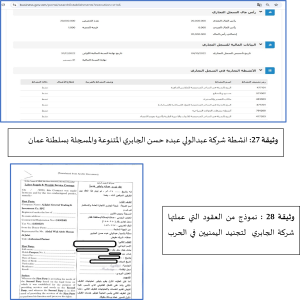
| Document 27: The diversified activities of Abdulwali Abdo Hassan Al-Jabri Company registered in the Sultanate of Oman |
| Document 28: A sample of contracts made by Al-Jabri Company to recruit Yemenis in the Russian-Ukrainian war |
Many international reports have recently talked about human trafficking practices involving companies to recruit Yemenis in the Russian-Ukrainian conflict (16). This raises significant moral concerns and highlights the desperate conditions in which some Yemenis may find themselves due to ongoing conflict and economic instability in the region. The militia’s recruitment tactics may exploit vulnerable individuals, contributing to broader issues of human rights violations and violations of international law.
The Houthi militia’s approach to military promotions and its participation in arms deals, and recruitment illustrates a multifaceted strategy aimed at consolidating power and enhancing military capabilities. Promotions of key figures within the NISS ensure that experienced commanders continue to shape militia operations. At the same time, the links between political figures such as Abdulwali al-Jabri and the arms trade underscore the complex interplay between governance and military activity in Yemen. Understanding these dynamics is critical to understanding the ongoing conflict and challenges to addressing accountability and human rights issues in the region.
5.4. Formatting and Arrangement Operations
Ahmed al-Shami (mentioned at the beginning of this report in paragraph 2.2), who is described as the economic coordinator of these companies and a member of the militia’s economic committee, plays a vital role in facilitating arms deals and disguised transactions in the form of legitimate trade. His participation includes:
- Strategic Planning: As the economic coordinator, al-Shami is responsible for developing strategies that allow the militia to maximize profits from these cover-up businesses. This includes identifying lucrative markets, negotiating deals, and managing logistics related to arms procurement and distribution.
- Facilitation of transactions: Al-Shami coordinates the financial aspects of these operations, ensuring that funds are effectively transferred and laundered to support arms smuggling without attracting undue attention. This may involve complex financial maneuvering , including the use of offshore accounts and shell companies.
- International Relations: His role extends to building relationships with international entities that may have been inadvertently involved in militia operations. By presenting these companies as legitimate, Shami can facilitate transactions that enable the militia to obtain weapons and materials while maintaining reasonable deniability.
5.5. Implications for Regional Security
The Houthi militia’s use of secret companies to conclude dubious secret deals, whether to purchase equipment, buy weapons, smuggle weapons, or even recruit Yemenis in the Russian-Ukrainian war has major repercussions on regional security:
- Arms proliferation: By engaging in arms smuggling, the militia contributes to the proliferation of weapons in a volatile region, exacerbating existing conflicts and undermining efforts to achieve peace and stability.
- Ambiguous accountability: The use of legitimate fronts complicates the ability of international authorities to hold the militia accountable for its actions. This challenges efforts to impose sanctions or investigate the illicit arms trade.
- Economic disruption: The operation of these covered companies can disrupt legitimate business in the areas where they operate , leading to unfair competition and economic instability.
The Houthi militia’s establishment of this type of company is an evolving strategy to facilitate arms smuggling while projecting an official image. By operating in seemingly legitimate sectors and using individuals such as Mohammed Saleh Mohammed al-Shami, al-Jabri, Ahmed al-Shami, and other camouflage names, the militia can effectively conceal its illicit activities. This approach not only supports its military objectives, but also poses significant challenges to regional security and international law enforcement efforts. Understanding these dynamics is critical The importance of addressing the broader effects of the Houthi militia’s actions in Yemen and surrounding areas.
The Houthi militia has established a robust surveillance and data collection system, which plays a critical role in its efforts to maintain control and monitor the opposition within the territory it occupies. This intensive surveillance device is designed to collect information on both supporters and opponents before the militia entered Sana’a specifically since 2012, allowing the militia to effectively manage and respond to potential threats.
When examining the documents and considering the quality of the data on the basis of which the information was collected, it is clear that there is support and assistance to these militias by international organizations and specialists to determine this quality and to use coding and analysis.
The Houthi militia uses various methods to conduct surveillance, including:
- Human Intelligence (HUMINT): The militia uses informants and undercover agents to gather information from within communities. These individuals often report on residents’ activities, loyalties, and feelings, providing the militia with real-time intelligence.
- Electronic surveillance: The militia has invested in technology that enables it to monitor communications, including phone calls, messages, and interactions on social media. This capability allows the militia to track opposition activities and collect data on individuals who may pose a threat.
- Physical surveillance: Houthi elements conduct surveillance on the ground to monitor individuals and groups deemed suspicious. This can include following individuals, monitoring gatherings, and gathering information about their movements and associations.
The militia maintains detailed records of individuals and their political affiliations, which form the basis of its intelligence operations. Important files obtained by the platform FraudWiki from 2013 that the militia worked on to survey a number of governorates reflect this practice:
Names and classifications for the year 2013: This file contains (in Excel format) thousands of names, including a file containing 1919 individuals in the governorates of Amanat Al-Asimah and Sana’a Governorate (Document 29) and other files that include hundreds of names in other governorates such as Al-Bayda Governorate (Document 30), in addition to various details used to classify them according to loyalty, political orientation and level of effectiveness. Classifications include:
- Loyalists: Individuals who support the Houthi cause and can be considered allies.
- Dissidents: Those identified as defectors or posing a potential threat to Houthi authority.
- Neutral parties: Individuals who do not publicly express support or opposition but can still be monitored because of their activities and affiliations.
The information in this file enables the militia to prioritize surveillance efforts, focusing on the individuals considered most likely to engage in opposition activities. The militia uses coding signals for much of the data to determine the degree of loyalty or not and then analyzes this information.
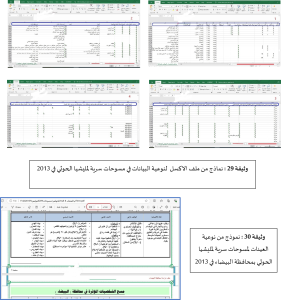
| Document 29: Samples of Excel file for data quality in secret surveys of the Houthi militia in 2013 for the Capital Secretariat and Sana’a Governorate |
| Document 30: Sample quality samples for secret surveys of the Houthi militia in Al-Bayda governorate in 2013 |
6.3. Surveys and intelligence gathering
In addition to keeping detailed records, the Houthi militia conducts surveys in various governorates to collect important data on individuals’ loyalties and affiliations. These polls play an important role in identifying potential threats and effectively managing the opposition. It also played an apparent role in imposing the Houthi militia’s control over Yemeni governorates in 2015.
The militia uses systematic methods to conduct surveys, including:
- Community Engagement: Surveys are often conducted through direct engagement with community members , sometimes under the guise of public safety initiatives or community development projects. This approach allows the militia to gather information without raising immediate suspicions.
- Targeted data collection: The militia focuses on gathering information about political beliefs, social ties, and community engagement. This data is essential to understanding the dynamics of loyalty and opposition within different regions.
It is clear that the process of developing the survey methodology was done through the help of experienced figures in determining the quality of the required data, coding and analyzing it, and also this assistance may have been obtained by the militia through international and local organizations, and as we mentioned, the surveys began practically from 2012 and continuously in the absence and lack of interest by the political parties in Yemen or even from the legitimate government currently.
6.5. The main persons of the survey process
Among the prominent figures involved in the survey and mentioned at the beginning of paragraph 2.2 of this report is Qassim Ahmed Qasim al-Hamran, (see Documents 14 and 15), who continued to play a key role within the militia. His participation highlights the militia’s reliance on individuals most loyal to the Houthi leader to oversee intelligence operations and ensure effective data collection efforts.
- Qasim al-Hamran‘s role: Al-Hamran’s position within the militia indicates that it plays an important role in shaping the strategies used for monitoring and data collection. His insight into community dynamics and loyalty patterns is valuable to the militia’s decision-making processes.
- Involvement in covert operations: Al-Hamran is also believed to be involved in covert operations aimed at suppressing dissent. His understanding of the local landscape enables the militia to carry out targeted actions against individuals identified as threats based on the data collected.
The Houthi militia’s extensive surveillance and data collection efforts are an integral part of its strategy to maintain control and management of the opposition in Yemen. By conducting comprehensive surveillance, maintaining detailed records, and using surveys to gather intelligence, the militia can effectively monitor the loyalties and affiliations of individuals within its territory. This approach not only helps identify potential threats, but also helps the militia consolidate its power and stifle dissent. Understanding these tactics is essential to understanding the broader implications of Houthi militia governance and its impact on human rights and civil liberties in the region.
Here, we renew the warning to the legitimate government authorities in the areas under their control to pay attention to the surveys carried out by the organizations and their partners, and it has previously been published about suspicious and security surveys of the European Institute for Peace and its advisers Huda Al-Salahi and Hisham Al-Omeisy (17), and it is also important to review the legitimacy and investigate with its affiliates, which may have officials who facilitated and enabled the continuation of such surveys.
- The role of international organizations and civil society institutions in Yemen
It is clear that there is a hidden role for some international organizations in Yemen as well as civil society institutions to provide various support to this militia, whether previously, and it is clear from the quality of the data found in the surveys of the Houthi militia in 2013, this work is not the work of the Houthi militia, but it appears that it was done through the help and support of organizations and intelligence that provided services to them and still do. Or whether this support is currently evident through facilitating the access of funds to the Humanitarian Relief Council (SCAMCHA).) affiliated with the militia or by exerting pressure through organizations to stop decisions against the militia, including classifying it as a terrorist group at the end of Donald Trump’s rule in 2020, or even what happened recently from the pressure exerted by the United Nations and its UN envoy in stopping the decisions of the Central Bank in Aden and pressuring the legitimate government under the pretext of human suffering and the economy.
7.1. The role of international organizations in Yemen:
Some international organizations in Yemen have played a role in supporting the Houthi militia by facilitating the access of international funds to and from them and their control over most of the projects implemented by these organizations and the common corruption between them, which contributed to harnessing many of the funding funds in the interest of the militia and the various security and military agencies, in addition to the reports and false information issued by some organizations, not to mention the silence of these organizations in the face of the kidnappings of their employees since 2020, and we cite there some of these international organizations with examples of what they have done:
- The Coordination Council for Humanitarian Affairs in Yemen (OCHA): It lists the security incidents to which UN organizations in Yemen and their employees are exposed, and shows that most of the security incidents by 95% occur in areas under the control of the legitimate government in 2022 (an analytical report by Frodwiki on the report of security incidents of organizations) (18), ignoring the forced abductions of the organization’s employees carried out by the Houthi militia since 2020 until now.
- The United Nations Development Program (UNDP): It has handed over tens of millions of dollars of demining funds (19) to the Houthi militia, which plants mines, and contributed to providing them with equipment and four-wheel drive vehicles that were used by the militia in the war or to enhance the capabilities of its security and military services. (20), an investigation was also conducted by the Public Prosecution into the program’s support for the Houthi militia in the demining program and reached the conclusion that it supports the militia with other United Nations programs (annex to document 31 of the investigation, which consists of 10 pages in 2023).
- The World Food Program (WFP): Through the billions of dollars in funds it received during the war, all of which were managed by the militia, and food was also found under the program’s seal in the front positions of the Houthi militia. (21)
- World Health Organization (WHO): Through the funds he received, which are hundreds of millions of dollars during the war, they were all managed through the militia, in addition to that it handed the militia many four-wheel drive vehicles such as ambulances, which the militia used to support its war fronts and security services and to transport its soldiers, and it roamed the streets of the capital, Sana’a , (22) in front of the eyes and ears of this organization.
- UNICEF Children’s Fund (UNICEF): The organization received billions of dollars in assistance to Yemenis during the war period and the organization occupies the second place through the volume of funding it received after the World Food Organization (WFP) in Yemen, the organization contributed to supporting the Houthi militia, in particular through the emergency cash transfers project for vulnerable families in Yemen, funded by the World Bank, whose funding amounted to more than $ 4.5 billion for the period from 2017 to 2023, as the organization manipulated the currency rate. Exploited the currency exchange difference between the areas controlled by the legitimate government and the areas controlled by the Houthi militia and looted the rights of these families through the game of banking at rates of more than 50% and up to hundreds of millions of dollars, not to mention the operational budgets and in partnership with the militia and with surprising silence from the legitimate government (23, 24 and 25), and this of course enabled the militia to seize funds to support and continue its war in Yemen and support its various agencies.

| Document 31: Document from an investigation carried out by the Public Prosecution in Marib 2023 on demining funds provided by the United Nations Development Programme and other organizations to the Houthi militia |
7.2. The role of some civil society institutions in Yemen
While this report sheds light on a serious issue represented in the roles and threats of the Houthi security and intelligence service, it also reveals the roles of some civil society institutions in Yemen in covering the crimes of this apparatus, beautifying its members with a twisted limb, and bringing them to the decision-making centers of UN organizations.
Previous reports also revealed the role of these institutions in transferring a large part of the international funds directed to support Yemen during the conflict period to the hands of the Houthi militia (previous reference 20), as there is cooperation and partnership, as well as the existence of a conflict in the roles between the officials of some international organizations and civil society institutions operating in Yemen, and some of them receive large funds without properly acknowledging them, and some documents indicate possible links between some of these organizations with the Houthi group.terrorist and providing various services to this militia, whether by beautifying it in the West or by attracting leaders from it and enabling it to attend international meetings and weave relations with UN officials and Westerners and show them as neutral individuals or to the extent of mobilizing efforts to stop any decisions that may be taken against the militia, whether such as decisions to classify it as a terrorist group or decisions related to the Yemeni economy, which may play a role in stopping the Houthi militia’s control over the economy, in addition to that some of these institutions play a role in covering the crimes of the militia The Houthis are represented by kidnappings, torture and killings, and they issue suspicious reports against the legitimate government to divert attention from the militia’s actions against humanitarian law. Our report stresses the need for in-depth investigations to review the performance of these institutions, hold long-handed accountable, and recover wasted or financial funds.
7.2.1.Role of Mwatana
Mwatana is a non-governmental organization run by Radhya Al-Mutawakel, and this institution identifies with the Houthi militia and falsely claims neutrality and work to promote democracy and human rights, but unfortunately it did not play any role to expose the Houthi militia’s abductions, torture and killings inside prisons for the Security and Intelligence Service and remained focused only in its roles and reports on distorting the legitimate government.
Mwatana receives tens of millions of dollars in grants, for example, a grant of 1.4 million euros in 2021 (26) These funds reflect the extent of international support for the soft power of the Houthi terrorist militia. Which did not disclose in any way the fate of the funds received and the ways in which they were used.
7.2.2. Role of the Sana’a Center for Strategic Studies
Sana’a Center for Studies was established in 2014, and it is an independent research center as it defines itself, this center plays a role in keeping pressure away from the Houthi militia, and this was represented in its position during the classification of the Houthi militia as a terrorist group during the era of Donald Trump in 2020, where it mobilized efforts, held meetings, and raised statements with many of their activists and affiliated with other institutions such as Resonate Yemen and DeepRoot to work to cancel this classification under the pretext of the humanitarian crisis and the deteriorating economic situation (27, 28 and 29)
The center also receives tens of millions of dollars in grants, for example, $ 4 million to hold a peace forum in the Netherlands in 2023 (30), where it brought figures from the leaders of the Houthi militia as peace activists and neutrals, including Jamal Amer, who was recently appointed Minister of Foreign Affairs of the Houthi militia (31)
Given the history of the center’s formation and presence in Sana’a in 2014, questions arise about: “Did the Sana’a center secretly contribute to supporting and assisting the Houthi militia in conducting the surveys that took place in the period before the militia entered Sana’a through its advisors, some of whom show no opposition to the Houthis or are loyal to different percentages?”
7.2.3.Role of DeepRoot Foundation and Hikma Program
Raafat al-Akhali and his wife Abeer al-Mutawakel own the DeepRoot foundation and the Hikam program, and Raafat al-Akhali and his wife Abeer al-Mutawakel have emerged as prominent figures in shaping the international narrative surrounding the Houthi militia. They have played important roles in presenting Houthi intelligence elements as neutral and development-oriented actors in various global forums. By sharing these elements with DeepRoot and the Hikma Fellowship ProgramThey facilitated the inclusion of Houthi leaders as advocates of peace and development and neutral individuals, despite their direct links to the militia. In addition, Al-Akhali played a role in mobilizing efforts with the Sana’a Center to stop the decision to designate the Houthis as a terrorist group in 2020.
Recently, through the Development Champions Forum and an institution called CARPO, Al-Akhali worked to hold a workshop in Jordan in June 2024 entitled “Steps to de-escalate the economy” against the measures of the Central Bank in Aden (32), and this played a role in enabling the UN envoy to exert pressure on the legitimate government to stop the decisions, which would have contributed to these measures if implemented in stopping the influence of the Houthi militia on the Yemeni economy and stopping the manipulation of currency exchange differences.
- This DeepRoot Foundation and Hikma serve as platforms to promote Houthi interests under the guise of humanitarian and development work, transitional justice and peace. By leveraging these entities, Al-Akhali and Al-Mutawakel were able to cultivate relationships with international stakeholders, including NGOs, governmental organizations and humanitarian agencies.
- Portraying Houthi leaders as neutral defenders allows them to gain credibility on the international stage, potentially rallying support or sympathy for their cause. This strategy is particularly effective in environments where Yemen’s humanitarian crisis is a focal point, as it enables the militia to distance itself from its more violent activities.
- The activities of Raafat al-Akhali and his wife come against the backdrop of serious allegations related to his portrayal of Houthi leaders as individuals, neutral activists and peace advocates, which enabled these individuals to reach and establish relations with UN agencies and reached to provide and enable leading Houthi figures to attend international meetings and meet with speeches at the Human Rights Council, and this figure is accused of war crimes, such as Abdul Qadir Al-Murtada.
- Ahmed AbdulAli Ahmed Al-Shami: This institution and program (DeepRoot & Hikam) presented him in more than one international forum and until attending a meeting in 2021 with the US envoy to Yemen as the director of a human rights organization (the Arab Organization for Human Rights “ARWA”) Attached is the picture of the meeting (33), which is Ahmed Shami, as we mentioned at the beginning of this report in paragraph 2.2, one of the Houthi leaders, a member of the militia’s economic committee, and the commercial coordinator of Houthi transnational companies that are active in illegal activities such as arms smuggling
- Amir al-Din Jahaf: This institution and the program (DeepRoot & Hikam) also presented him in more than one international forum as a human rights activist (34), and he is rather a Houthi leader (35) and owns an institution called the Human Foundation that works ostensibly to defend human rights, but it is in fact one of the institutions created by the militia apparatus to beautify its image in the West and push the Houthi narrative at the forefront in front of UN agencies, and this is what was explained in my report and the secret organization of the Houthis in international organizations and funds (previous reference 3)
- Through the roles of Al-Akhali and Al-Mutawakel, which we mentioned, Ahmed Al-Shami, Amir Al-Din Jahaf and their institutions were able to reach the corridors of the United Nations, and even Al-Shami became known as working near the representative of the Secretary-General of the United Nations in Yemen (36),
- At a later stage, they worked (Al-Shami and Jahaf, with the help of Muhammad Reda Al-Wazir and through their institutions) to enable one of the security elements of the Houthi militia, AbdulQader Al-Murtada, who is in charge of Houthi prisons and accused of torturing prisoners in prisons, for the Houthi militia, to deliver an online speech at the Human Rights Council in Geneva in 2019(37) This situation raises moral concerns about the participation of individuals with such serious allegations in high-level international platforms.
- The facilitation of Murtada’s participation in this event was organized through the Arab Organization for Human Rights (ARWA), led by Muhammad Reda Al-Wazir and Ahmed Al-Shami, as well as the Ensan Organization, affiliated with Amiruddin Jahaf. This link highlights how militias can leverage organizations that claim to defend human rights to advance their agenda.

Photo from April 2021 meeting organized by DeepRoot and Hikma Fellowship Program with U.S. Envoy
And attended by Ahmed Shami as an activist and neutral
The involvement of institutions such as the Sana’a Center, Mwatana, DeepRoot, and Hikma in facilitating the visibility of Houthi leaders in international forums raises important questions regarding accountability:
- Access to international platforms: There are pressing concerns about how these institutions can access influential international platforms. Their ability to present Houthi figures as advocates of peace and development while ignoring their direct involvement in human rights abuses reflects a troubling dynamic in international diplomacy.
- Lack of accountability: The failure to hold these institutions accountable for their roles in advancing Houthi interests under the guise of humanitarian action is deeply troubling. It highlights a broader issue of accountability within the international community, where actors with questionable human rights records can manipulate perceptions in their favour.
- Open threats and impunity: The situation is further complicated by the fact that these figures like Abdulqader El Murtada have publicly threatened individuals like Fathi bin Lazraq on social media (38). These actions demonstrate a blatant disregard for accountability and the rule of law, particularly given their involvement in serious human rights violations. The ability of Houthi leaders to act with apparent impunity is sounding alarm bells regarding the effectiveness of international mechanisms aimed at protecting human rights and promoting accountability.
- Non-compliance with the law: Also, figures such as Raafat Al-Akhali claim to abide by the law and receive funds related to law and justice, but they are far from that, but they flout the law and refuse to obey it, and recently Al-Akhali was tried wisely by Marib Court and sentenced against him as a fugitive from the face of justice and 4 months in prison with enforcement and referral of his institution for investigation (39).
The roles of Mwatana, Sana’a Center, Hikma Program, and DeepRoot in shaping the narrative about the Houthi militia illustrate the complexities of international relations in the context of the conflict. By leveraging organizations and civil society organizations that offer a humanitarian interface, it enables the militia to engage with international stakeholders while obscuring its most violent and repressive actions. Showing Houthi leaders as neutral individuals, mobilizing efforts to stop international resolutions against the Houthi militia, as well as facilitating The participation of figures such as Abdulqader Al-Murtada in international human rights meetings and the broader implications of their actions highlight the urgent need for scrutiny and accountability within the international community regarding its interactions with human rights violations. Understanding these dynamics is essential to address the ongoing humanitarian crisis in Yemen and ensure that efforts to achieve peace and stability are truly effective and inclusive.
Conclusion
The complex dynamics of Houthi militia operations reveal a multifaceted approach to governance, security, and international relations. The establishment of the HSIS has enabled the militia to effectively consolidate its power while using extensive surveillance and data collection strategies to monitor supporters and opponents alike. Key figures within the militia, such as AbdulWahid Naji Muhammad Abu Ras, Hassan al-Kahlani, and AbdulSalam Salah Ahmed Fleita, play critical roles in coordinating intelligence activities and managing military operations, strengthening the militia’s grip on the militia.The Authority, in addition to its various abductions, torture and killings inside Yemen
The militia’s use of clandestine companies through the Ahmed al-Shami commercial coordinator for arms smuggling and recruitment operations reflects its ability to adapt to a complex conflict environment. These operations not only enhance the militia’s military capabilities, but also pose significant challenges to regional security and stability. The involvement of political figures such as Abdulwali Abdo Hassan al-Jabri in illicit arms deals underscores the complexity of governance and military actions within the Houthis.
Moreover, the abductions of activists, media workers and employees of international organizations, methods of torture and multiple malicious charges, which may also be a kind of partnership to cover up corruption, raise a broad question about the accountability and effectiveness of international mechanisms designed to support human rights, which in turn raises the question of the role of some civil society institutions in Yemen in presenting some Houthi militia leaders as neutral and development-oriented figures in international forums. This complicates the narrative surrounding the militia. Their engagement with institutions such as the Sana’a Center, DeepRoot, and the Hikma Fellowship Program raises important questions about accountability and the effectiveness of international mechanisms designed to track and investigate such cases.
As the situation in Yemen continues to evolve, understanding these dynamics is essential to understanding the broader implications of the Houthi militia’s actions. The interplay between military promotions, surveillance tactics, arms deals, and international relations highlights the urgent need for the international community to address the ongoing humanitarian crisis and ensure that efforts to achieve peace and stability are real, effective and inclusive. The challenges posed by the Houthi militia underscore the complexity of the conflict in Yemen and the critical importance of holding all actors accountable for their actions.
References:
PDF report link:
The Houthi Security and Intelligence Service (HSIS) -first part

