
Legitimizing the Houthi Militia By “Peace” Lobbies and Directed Researches
International Narrative Engineering in Yemen
April 2025 – FraudWiki
Introduction:
Since 2015, Yemen has faced an escalating humanitarian catastrophe due to prolonged conflict, resulting in deteriorating economic and social conditions, rising poverty rates, and critical shortages of food and medicine. In response, international funding has emerged as a primary tool for crisis mitigation. However, its effectiveness has been severely undermined by corruption, mismanagement, lack of transparency, and the diversion of aid to specific institutional networks aligned with narrow agendas.
Between 2015 and 2024, donors channeled approximately 32 billion dollars into Yemen through international organizations and UN agencies. Additional hundreds of millions of dollars were funneled through the European Union to handpicked institutions under thematic umbrellas such as peace, justice, and the rule of law, often nothing more than superficial slogans lacking implementation.
Amidst this, a network of research and human rights organizations surfaced, presenting themselves as independent while serving as soft instruments for legitimizing the Houthi project. These entities have played a key role in reframing the group internationally as a legitimate political actor while concealing its true identity as an Iranian-backed coup militia. They submitted reports that portrayed the Houthis as a persecuted entity, ignoring their role in dismantling the Yemeni state and seizing its institutions.
As the war intensified, these research centers evolved into an international lobbying apparatus that rebranded Houthi actions and embedded their narratives within diplomatic systems. This led to monopolization of international discourse on Yemen, marginalizing independent Yemeni voices and elevating Houthi-aligned individuals under the false pretense of neutrality. These reports distorted facts and granted the Houthis an unjustified political shield.
Consequently, the international community has become complicit, persistently advocating for a negotiation process that grants the Houthis power-sharing opportunities while overlooking their function as a tool of Iranian regional ambitions. These policies have empowered the Houthis further and weakened the legitimate state. In this reengineered reality, international reports increasingly rely on sources affiliated with lobbying networks sympathetic to the Houthis.
Now labeled as the de facto authority, the Houthis are legitimized while the recognized government and the coalition are blamed for the humanitarian catastrophe. This undermines genuine efforts to reestablish the state and emboldens actors with vested interests to manipulate narratives and recycle political legitimacy for the militia.
Simultaneously, authentic national actors striving to restore the Yemeni state are sidelined while millions of dollars are funneled into hollow peace initiatives that merely serve lobbying interests rather than building institutional capacity. This has entrenched militia control over political decision-making and reduced peace to a superficial reproduction of the existing power structure.
The international community is no longer an impartial observer, it has evolved into a contributor to the crisis by financing efforts that reinforce the status quo and institutionalize impunity.
This report seeks to unpack the concept of international narrative engineering and illustrate how the international community, alongside peace advocacy networks and politicized research, has contributed to legitimizing the Houthi militia, thereby obstructing state-building, governance, and transitional justice in Yemen.
We define international narrative engineering as the strategic shaping and manipulation of discourse and narratives by international actors including governments, NGOs, and media that determine global understanding of the Yemeni conflict. These narratives either bolster or undermine the legitimacy of the Houthi militia.
To explore this, the report addresses several critical questions across interrelated themes, drawing on documented case studies and evidence:
- How do research centers function as tools for legitimizing the Houthi militia at the expense of the Yemeni state
- How are independent Yemeni voices displaced in favor of actors aligned with foreign agendas that disregard principles of governance and transitional justice
- What role does international discourse play in redefining political legitimacy in Yemen according to foreign interests rather than the Yemeni people’s will
- How are reports by the UN and international organizations instrumentalized to justify Houthi practices and sustain their influence, thereby obstructing paths to state-building and good governance
First: The Role of Directed Researches and International Organizations
Some international organizations use research to influence policies in favor of groups like the Houthi militia. This undermines governance in Yemen and often reflects private agendas, not state-building or justice.
Key points:
- Peace over justice: The international community prioritizes peace and counterterrorism, even if it weakens institutions and ignores Houthi violations.
- UN pressure in 2024: The UN pushed the Central Bank in Aden to suspend its decisions (1). There were even threats to transfer funds by air to Houthi areas if the legitimate government insisted on its policies (Attach 1).
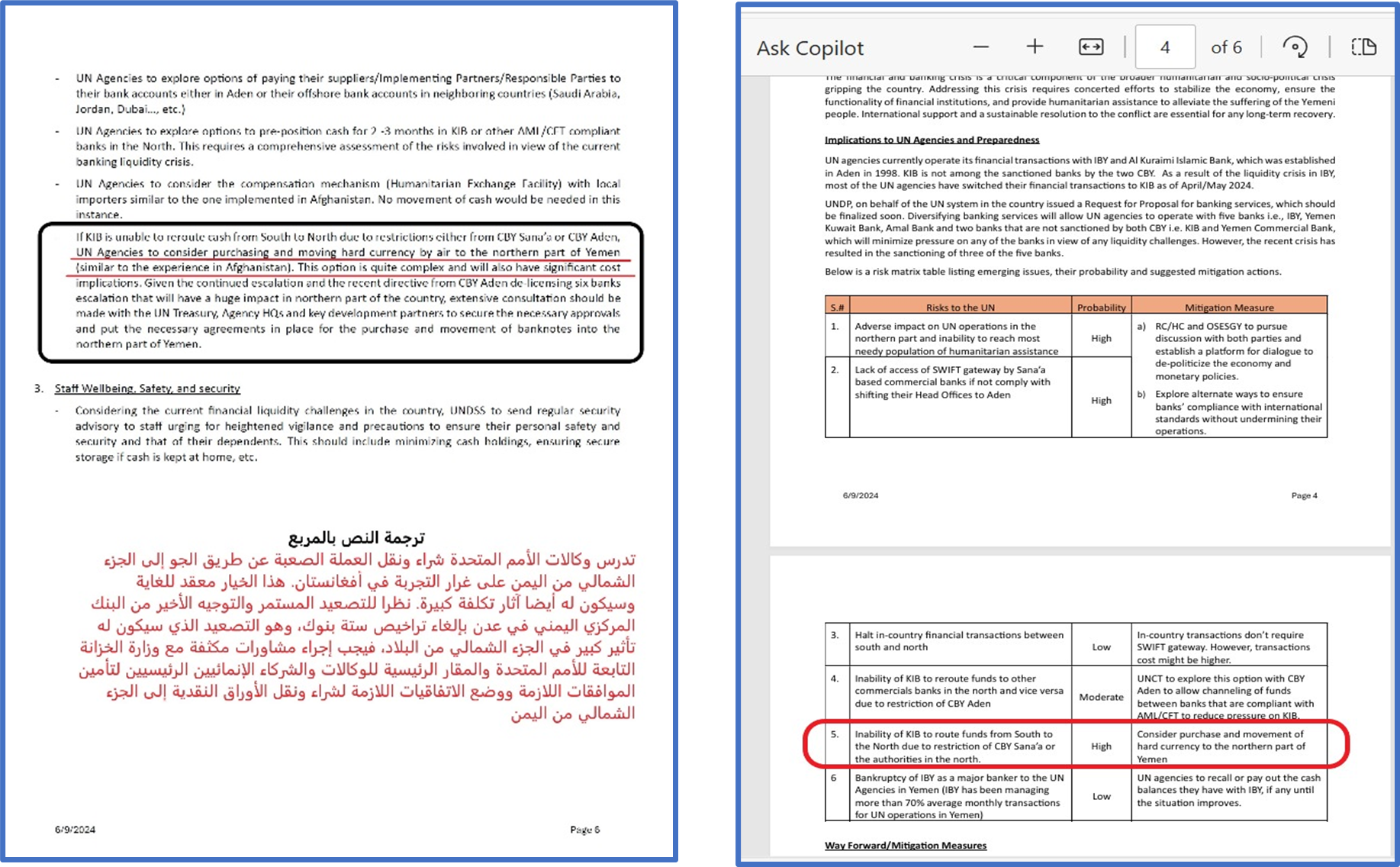
Attachment 1: Memorandum on the measures to be taken by the UN envoy and UN organizations against the decisions of the Central Bank in Aden
- Security alliances have been exploited by the Houthis to appear as partners in counterterrorism (e.g., Al-Bayda & Rada’a events in 2024).(2)
- Political elites often engage in fake dialogues while actually polishing the image of the militias, using the humanitarian crisis as a tool.
- UN manipulation: The influence of certain NGOs within the UN system has prevented accountability for war crimes in Yemen.
- Hosting sanctioned figures: Abdulqader Al-Murtadha spoke at the UNHRC in Geneva (2020) (3), (Attach 2), He is currently on the US sanctions list (4). This hosting was arranged by:
- Insan (Ameer Al-Din Jahaf)
- Arwa (Ahmed Al-Shami, Mohammed Reda Al-Wazir)
And promoted through (5 &6):
- DeepRoot (Rafat Al-Akhaly, Alaa Qasem)
- Resonate Yemen (Rafat Al-Akhaly, Alaa Qasem)
- Hikma Fellowship (Abeer Al-Mutawakil, wife of Rafat)
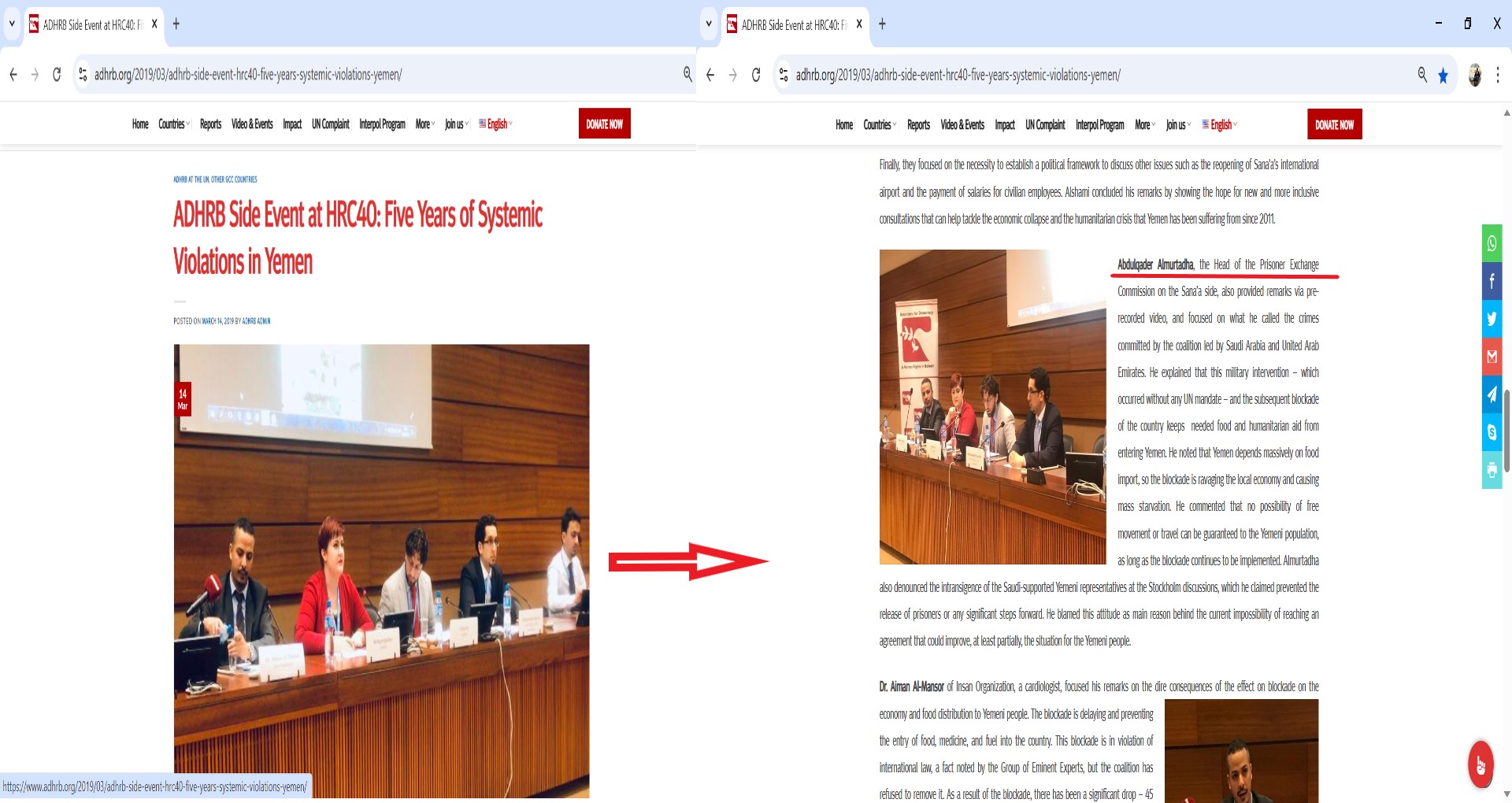
Attachment 2: Hosting of Abdulqader Al-Murtadha as a speaker at the UN Human Rights Council in Geneva 2020
- Focus on Narrow Solutions:
The international community often focuses on political solutions between the internationally recognized government and the Houthi militia, while neglecting genuine political actors and qualified national voices. This makes any sustainable peace agreement difficult.
(Examples include the 2018 Stockholm Agreement on Hodeidah, which prevented the entry of legitimate forces into the city and handed the port over to the Houthi militia, as well as the alternative ship Nautica which was handed to the militia, in addition to the continued presence of the Safer ship in 2023, allowing the Houthis to possess two threats and maintain environmental risk.) (7)
- Weak Justice Mechanisms:
The global legal system fails to provide a clear path to hold the actors responsible for the harm caused to the Yemeni people. Unfortunately, some research centers play a role in distorting the concept of transitional justice and exaggerating the role of organizations in the humanitarian aid provided to Yemen.
- Reconciliation Challenges:
Yemen’s complex social fabric, consisting of sectarian, tribal, and local dynamics, has eroded due to conflict. Systematic violations of human rights and international law have widened the gap between power centers in different communities.
How does Directed Researches contribute to this?
Directed researches may contribute to undermining state-building, governance, and transitional justice in Yemen through:
- Shaping Policy:
Directed researches may be used to influence international strategies and policies related to Yemen, which could result in prioritizing certain interests at the expense of state-building, justice, and good governance.
This is where funding and grants are given to specific civil society centers and institutions, which in turn produce or direct reports and research to serve the interests of the funders.
Examples include funding from Open Society Foundations, owned by Jewish businessman George Soros, providing annual grants of up to $200,000 to each of the following:
- Mwatana Organization led by Radhya Al-Mutawakkil (8)
- Sana’a Center for Strategic Studies led by Majed Al-Madhaji and Farea Al-Muslimi (9)
Additionally, other institutions connected to the Yemen file include the Royal Institute of International Affairs (Chatham House) (10), where Farea Al-Muslimi works as a researcher, and which receives average funding of $1 million annually.
Have these funds been used to direct specific policies and produce reports in line with donor agendas? These entities are known for actions that serve the Houthi militia, polish its image in the West, block any international decisions against the group, and justify their efforts under the cover of the humanitarian and economic crisis.
- Ignoring Local Voices:
Directed researches may ignore or downplay Yemeni voices and their needs, leading to ineffective and unsustainable solutions.
- Misleading Public Opinion:
Directed researches may be used to spread misleading or distorted information about the situation in Yemen, making it more difficult to achieve peace and justice.
It also leads to greater investment in prolonging the war or maintaining the current state of affairs, which results in what is called the bleeding of funds allocated for peace or humanitarian relief, and the creation of a dependent society. (11)
Second: Research Centers as Tools for Narrative Production
- Narrative Production:
Some research centers are used to generate narratives that legitimize the Houthi militia’s control, by highlighting specific issues while ignoring others.
(Examples include Mwatana’s efforts to whitewash Houthi crimes, and the Sana’a Center’s obstruction of international efforts to classify the Houthis as a terrorist group. The center’s role was evident in 2020 and 2021 after President Trump’s decision, as it opposed the terrorist designation (12). This role has re-emerged in 2025 following the latest designation, again using the humanitarian and economic crisis as a justification (13)).
- Selective Analysis:
Certain analytical approaches are adopted to support specific narratives, strengthening the Houthi position at the expense of the state.
How do research centers become tools for producing narratives that legitimize Houthi control over the Yemeni state?
- Conditional Funding:
Some centers receive funding from donors with special interests in Yemen, including those who directly or indirectly support the Houthis. Such funding can influence the type and outcome of research, leading to narratives that serve the Houthi agenda.
- Selective Focus:
Some studies selectively emphasize certain aspects of Yemen’s situation, such as historical grievances or mistakes by the legitimate government, while ignoring or minimizing Houthi violations.
An example is the abduction of UN staff, aid workers, and activists, which started in 2020. International organizations and rights-based CSOs remained silent until 2024 and even then, issued only weak statements.
- Amplifying Houthi Narratives:
Certain research centers magnify the Houthis’ narrative, portraying them as representatives of the people, fighters of corruption, or as an oppressed minority without any critical analysis.
- Hosting Pro Houthi Analysts:
Some centers host analysts or researchers known for their pro Houthi leanings, offering them platforms to promote their views. In some cases, individuals or platforms are financially supported to host these figures under the guise of neutrality. Examples:
- One TV program appears to have become dedicated to guests nominated by a specific center. A similar pattern is followed by a particular media platform. (14, 15, 16)
- Notable Interventions: Nadia Al Sakkaf, former minister, and Abdullah Sultan Shaddad, Director of the Legal and Social Peace Foundation, participated in a recent peace forum in Jordan organized by the Sana’a Center. (17, 18, 19)
Nadia’s speech was a striking example of narrative manipulation. At the International Yemen Forum, she addressed donors in English only, with no live translation, clearly signaling that Yemenis were not her real audience but international decision makers whose money she was encouraging regardless of how it would be used. She used emotional metaphors, comparing children before 2014 and after 2015. (Attach 3)
Meanwhile, Abdullah Sultan Shaddad, at the same forum, forgot that he represents a neutral civil society organization. He began speaking on behalf of the Houthi militia, praising their “responsiveness,” indirectly blaming the other side for being uncooperative. (Attach 4)
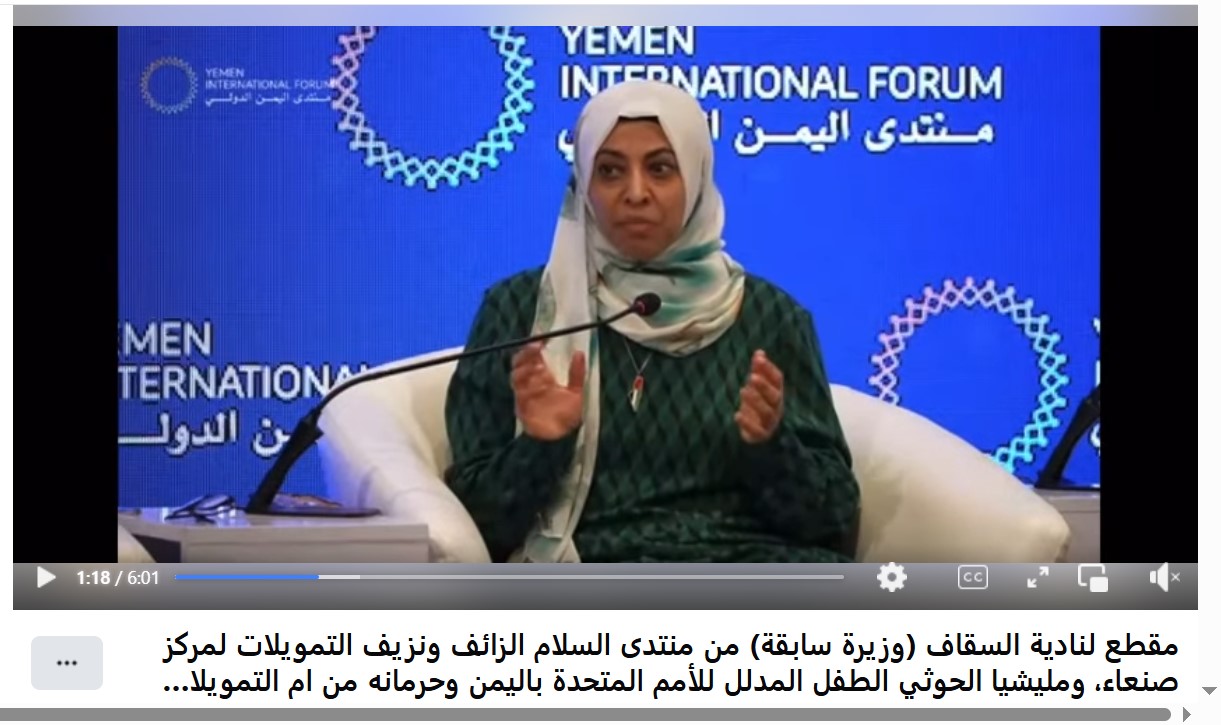
Attachment 3
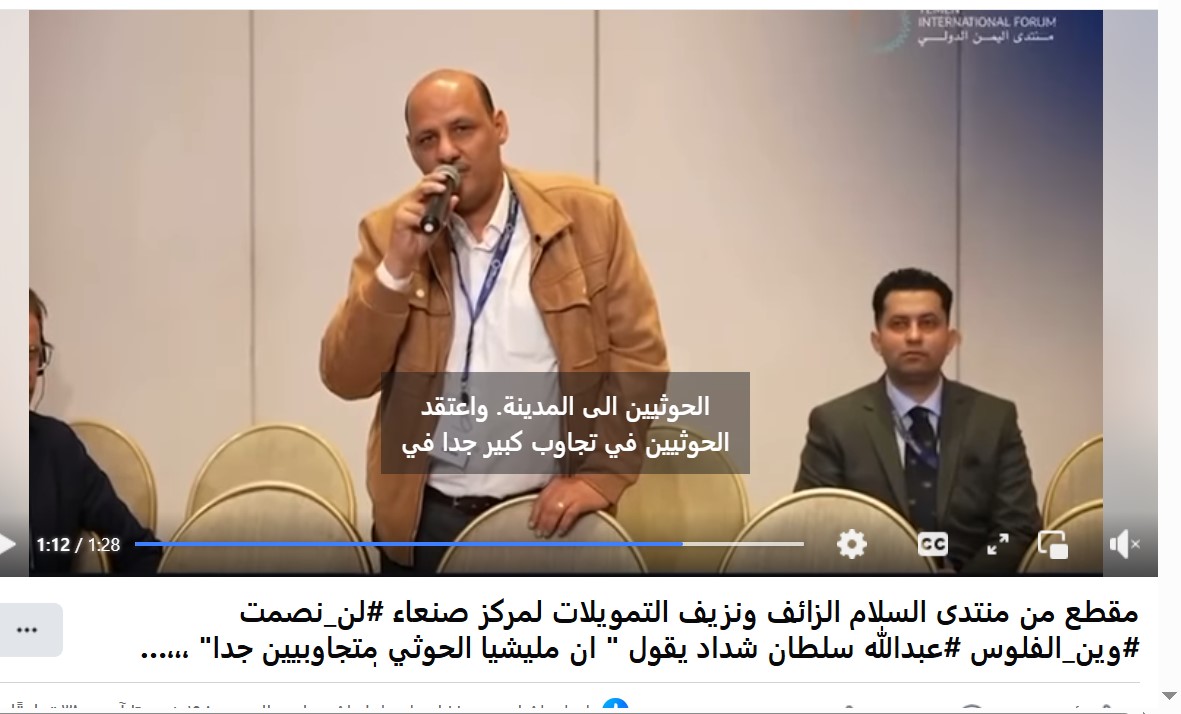
Attachment 4
- Farea Al Muslimi, former director of the Sana’a Center and now a researcher at Chatham House, regularly publishes analyses and posts, some bordering on political blackmail.
Farea Al Muslimi is one of those who built influence at the expense of the Yemeni people’s suffering. He opposed classifying the Houthis as a terrorist group in 2020. When Canada made the designation, he mocked it in a post asking, “Will the designation prevent Houthis from chanting slogans on Montreal’s subway” (20, 21) (Attach 5).
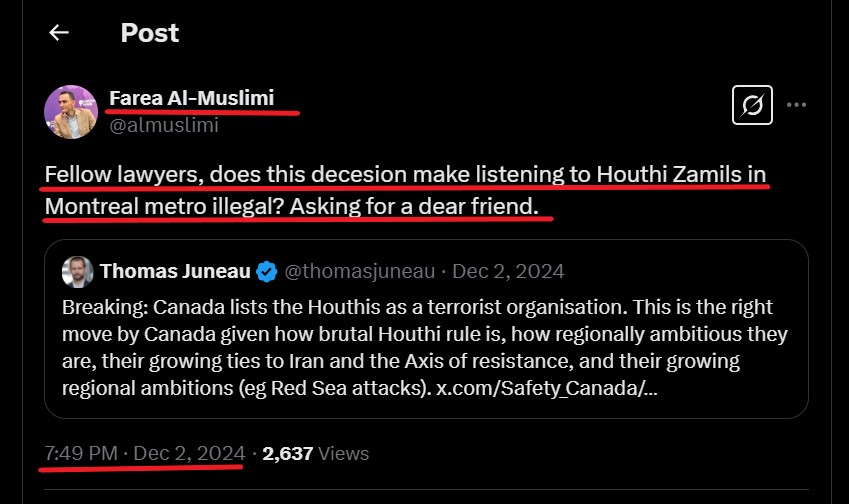
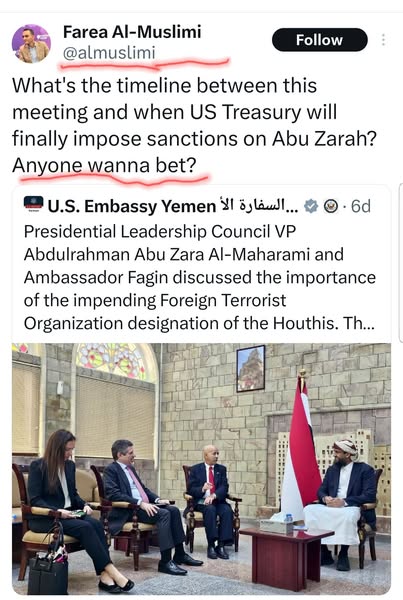
Attachment 5: Examples from tweets by Farea Al-Muslimi, former director of the Sana’a Center and researcher at Chatham House
- Khaldoun Bakhail’s Report: A report by Khaldoun Bakhail (consultant at the Geneva Centre for the Democratic Control of Armed Forces DCAF), published through the Italian Institute for International Political Studies (ISPI), claimed that the security sector is inconsistent and largely outside Houthi control. However, he placed blame on the legitimate government and its forces for recruiting minors. (Attach 6) (22). In the same report, the term “militia” was used more than 15 times, all referring to government-aligned forces.
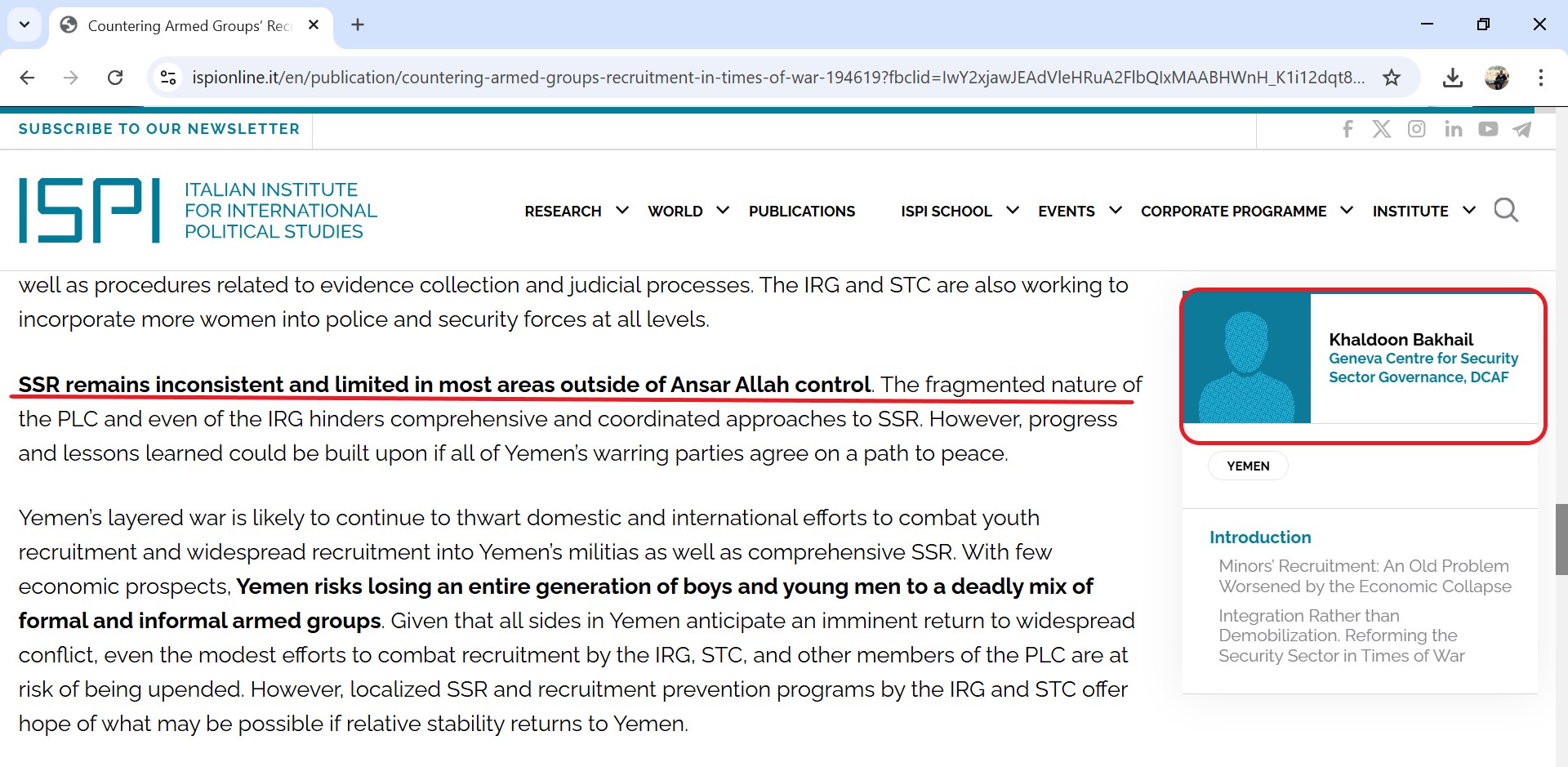
Attachment 6: Excerpt from Khaldoun Bakhail’s ISPI report
- Additionally, there are multiple publications by Khaldoun Bakhail attempting to reduce pressure on the Houthi militia. In some, he alleged the spread of unknown diseases in Houthi-controlled areas, warning of famine. (23), Such claims are often marketed under the banner of the “humanitarian crisis” using journalists or media platforms to promote the narrative. It appears Bakhail exploited his position at DCAF to facilitate the attendance of specific individuals or media outlets at conferences held in Europe. This contributes to the exclusion of genuine Yemeni voices and experts. He has also communicated with other activists to promote this narrative, and some of these communications were later revealed. (24), One of his tweets appeared shortly after U.S. President Trump reclassified the Houthi militia as a terrorist organization in January 2025. (Attach 7).
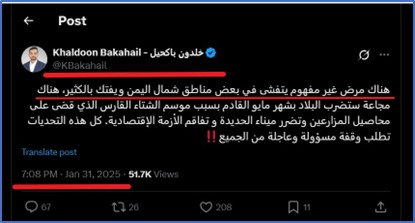
Attachment 7: Screenshot of Khaldoun Bakhail’s tweet in January 2025 spreading Houthi health-related propaganda to counter the terrorist designation
- Exclusion of Local Experts:
Local expertise on Yemen’s political, economic, or environmental conditions is often ignored. This vacuum is exploited by a select group of organizations that monopolize funding for peace, justice, law, and rights. These institutions rotate roles among each other, including Mwatana (Radhya Al-Mutawakkil), the Sana’a Center (formerly led by Farea Al-Muslimi, currently by Majed Al-Madhaji), DeepRoot, Resonate Yemen (Rafat Al-Akhaly and Alaa Qasem), and the Hikma Fellowship (Abeer Al-Mutawakkil). They have transitioned from human rights and peace grants to climate finance, promoting select individuals repeatedly and sidelining genuine experts.
Recently, these institutions have turned toward climate funding, showcasing individuals with no real connection to climate work. This undermines national expertise and risks wasting funds, as seen with previous humanitarian, peace, and legal projects.
Example: On November 27, 2024, the Sana’a Center organized a climate financing workshop in Jordan with the EUinYEMEN. (25)
The event included participants with no real background in climate, who had previously been promoted by DeepRoot, Resonate Yemen, or Hikma Fellowship. These same institutions then positioned themselves to capture climate-related grants, despite lacking the qualifications, echoing previous misuse of peace and humanitarian funds.
DeepRoot’s Role: In each funding cycle, DeepRoot promotes certain figures through the Hikma Fellowship, labeling them as “development leaders.” Some include Houthi-aligned individuals presented as neutral, such as Ahmed Al-Shami. This was revealed in prior reports. (26)
In the current cycle, DeepRoot promoted Ghadir Al-Tairah, branding her as a climate expert. However, she has been accused of taking control of a Yemeni climate foundation’s website, stealing ideas, and misusing others’ data. A formal complaint has been filed in Yemen. Al-Tairah and her colleague Ruqayya Al-Ghuli have refused to respond to legal proceedings or return the site. She appeared in Hikma’s third cohort (27), later in a meeting with the former UN envoy arranged by Hikma, and was then promoted in climate finance discussions by the Sana’a Center. (P. 25) (Attch 8).
Sana’a Center’s Partnerships: The center has included individuals previously involved in discrediting Yemen during global climate conferences. At COP26 in the UK (2021), Ammar Al-Awlaqi, then head of Yemen’s Environment Authority, in coordination with current Minister Tawfiq Al-Sharjabi, enabled individuals with no government affiliation or environmental background to attend the summit. This was reportedly done to facilitate their entry into the UK and apply for asylum. This act is described as “human smuggling.”
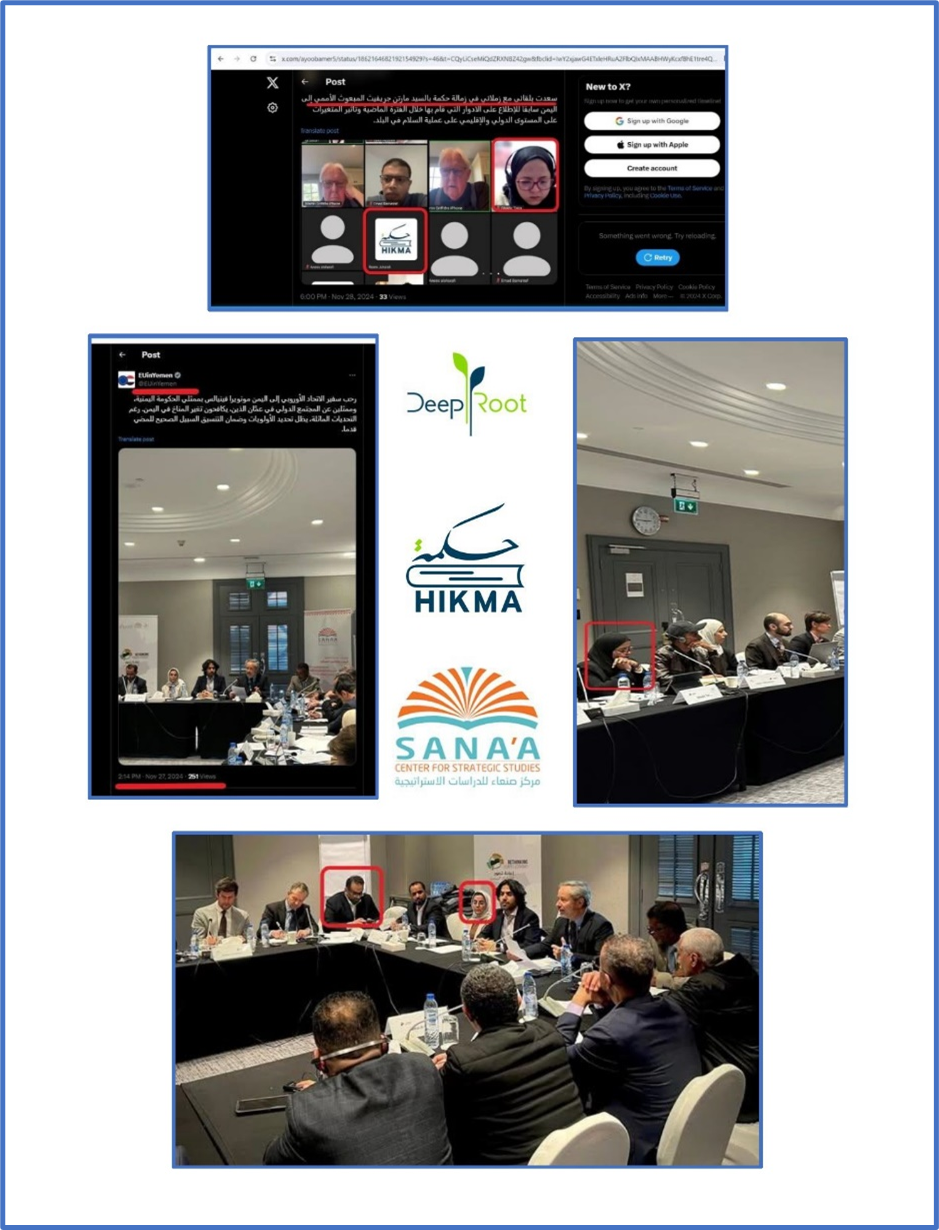
Attachment 8: Example of promoting unrelated individuals in international climate forums
- Exclusion of Victims:
Victims of the conflict are often excluded from political dialogue and decision-making processes, denying them their voice in transitional justice discussions.
- Exploitation of Humanitarian Needs:
Some international organizations exploit Yemenis’ urgent needs to push political agendas or empower specific individuals at the expense of others.
Third: International Discourse and the Reshaping of Political Legitimacy
- Interests of Power Players:
Political legitimacy is being reshaped based on the interests of international powers rather than the will of the Yemeni people. This weakens efforts to build the state, eliminate militias, and uphold transitional justice.
- Negative Impacts:
Such discourse may undermine any efforts to build a political system that reflects the aspirations of the Yemeni people.
What role does international discourse play in reshaping political legitimacy in Yemen according to the interests of powerful actors, rather than the will of the Yemenis?
- Implicit Recognition of the Houthi Militia: By focusing on dialogue with the Houthis as a main party to the conflict, there is an implicit recognition of their legitimacy, despite the fact that they did not come to power through free and fair elections.
- Ignoring International Legitimacy: Some international powers overlook UN Security Council resolutions related to Yemen, which support the internationally recognized legitimate government. This is evident in the funding provided by certain European Union countries, especially the Netherlands, to entities that support the Houthi militia. Additionally, the United Nations in Yemen channels funding through institutions affiliated with the Houthis, such as the Houthi-run Supreme Council for Humanitarian Affairs, while major UN organization offices remain in Sana’a.
- Focus on “Realistic Solutions”: Support for the Houthis or overlooking their violations is often justified on the grounds that they are a “de facto” power on the ground, and that a political solution requires engagement with them.
- Redefining “Legitimacy”: There is an attempt to redefine the concept of legitimacy in Yemen based on territorial control or administrative capacity rather than adherence to the constitution and rule of law. This trend must be closely monitored.
Fourth: The Use of United Nations Reports
- Interpretation of Reports: UN reports are used to justify the practices of the Houthi militia, undermining efforts to build a state based on good governance. For example, OCHA’s security incident reports in Yemen in 2022 and 2023 often contradict reality. Many incidents affecting organizations and their staff in Houthi-controlled areas are omitted or selectively reported. (28)
- Impact of International Organization Reports: These reports may serve as political tools to provide certain actors with legitimacy or justify the continuation of the current situation, often under the pretext of the humanitarian crisis and economic deterioration to ensure ongoing funding.
How are UN and international organization reports used to justify Houthi practices and organizational corruption in humanitarian funding, while weakening any potential path toward building a state based on good governance?
- Bias in Data Collection:
There may be bias in how data and information are gathered for UN and international organization reports, leading to inaccurate or distorted representations of the situation in Yemen. As previously mentioned with security incidents (P. 28), another example is population and IDP data. In 2020 and 2021, organizations published reports on Yemen’s food insecurity phases, including population breakdowns by governorate. The WASH Cluster report by UNICEF is a clear case of data manipulation, enabling aid mismanagement and casting doubt on the effectiveness of assistance, while weakening efforts to build a governance-based state. For example, reports listed Marib’s population as 495,000 and IDPs at 300,000.
To expose this manipulation, a map based on Google Earth imagery of Al-Jufaina camp in Marib was created. The camp’s area was 2,138,695 square meters (red-dotted boundaries). According to international Sphere standards, each IDP requires 3.5 sqm. This means the camp alone would hold around 611,055 individuals, contradicting the official reports that the entire Marib governorate hosts only 300,000 IDPs. This wide discrepancy is strong evidence of deliberate data manipulation. (Attach 9)
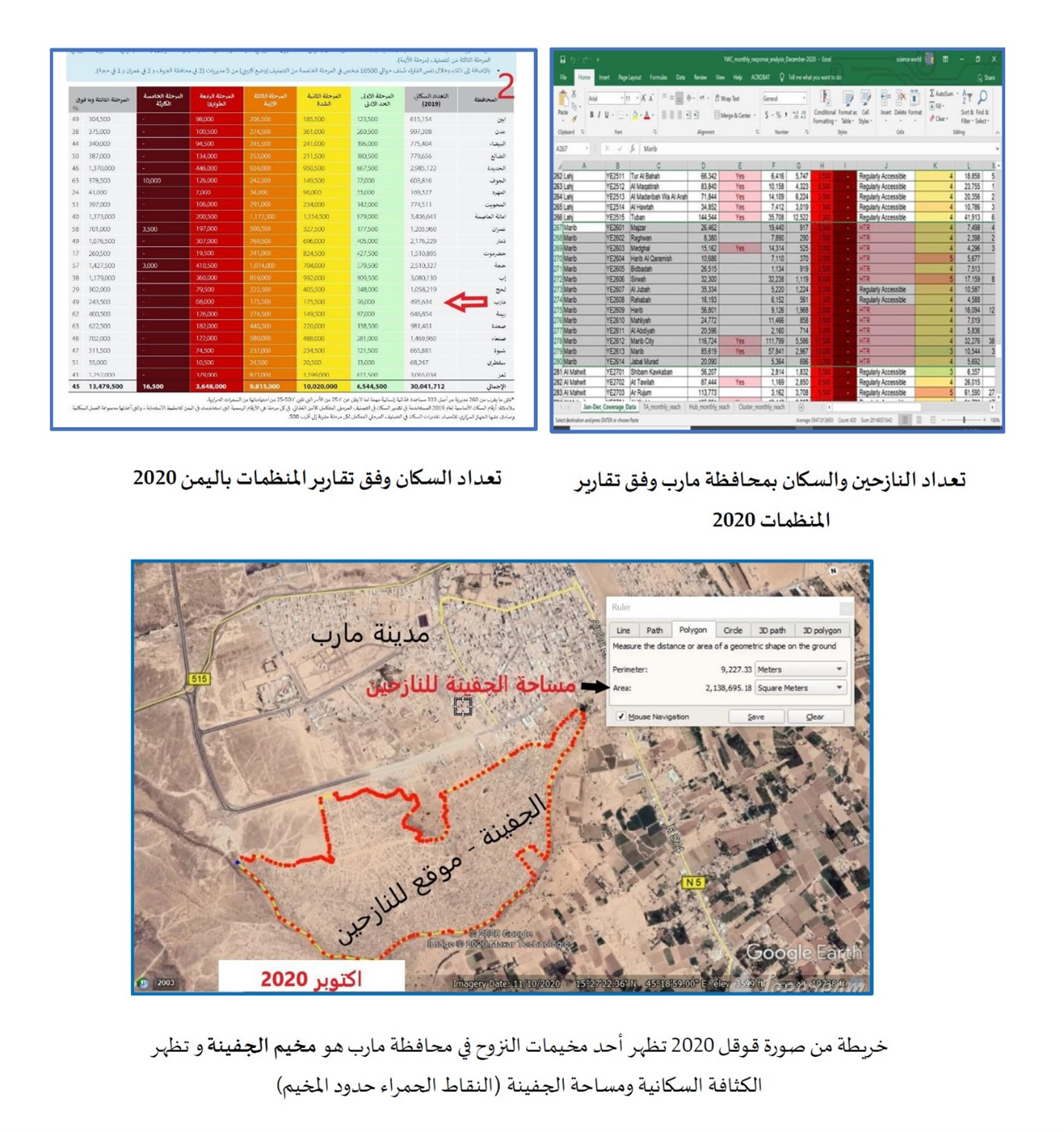
Attachment 9: Example exposing manipulation and misinformation regarding IDP and population data in Marib
- Focus on Government Mistakes and Distortion of Facts:
Some reports excessively highlight government shortcomings while minimizing or justifying Houthi violations. An example is a statement issued by the “Accountability for Human Rights” foundation concerning the suicide of Rashid Alawi Al-Hattam in the Political Security Prison in Marib. (Attach 10) (29). The statement, dated February 12, 2025, concluded torture and murder without evidence or awaiting investigation outcomes.
Governor of Marib formed an investigative committee including security officials and a family representative. The committee (headed by Brig. Gen. Dr. Abdulhamid Al-Hammadi from the Ministry of Interior) announced its findings on February 22, 2025, confirming suicide with no external foul play. (30)
That same day, Marib’s Public Prosecution Office published an official statement affirming it is the only authorized body to investigate and issue findings. (31)
On March 10, 2025, Decision No. (30) in Case No. (16) of 2025 was issued by the Public Prosecution in Marib, confirming the incident was a suicide with no criminal involvement.
This example shows how some civil society organizations distort facts and rush to publish unsubstantiated statements, highlighting the need for oversight and accountability.
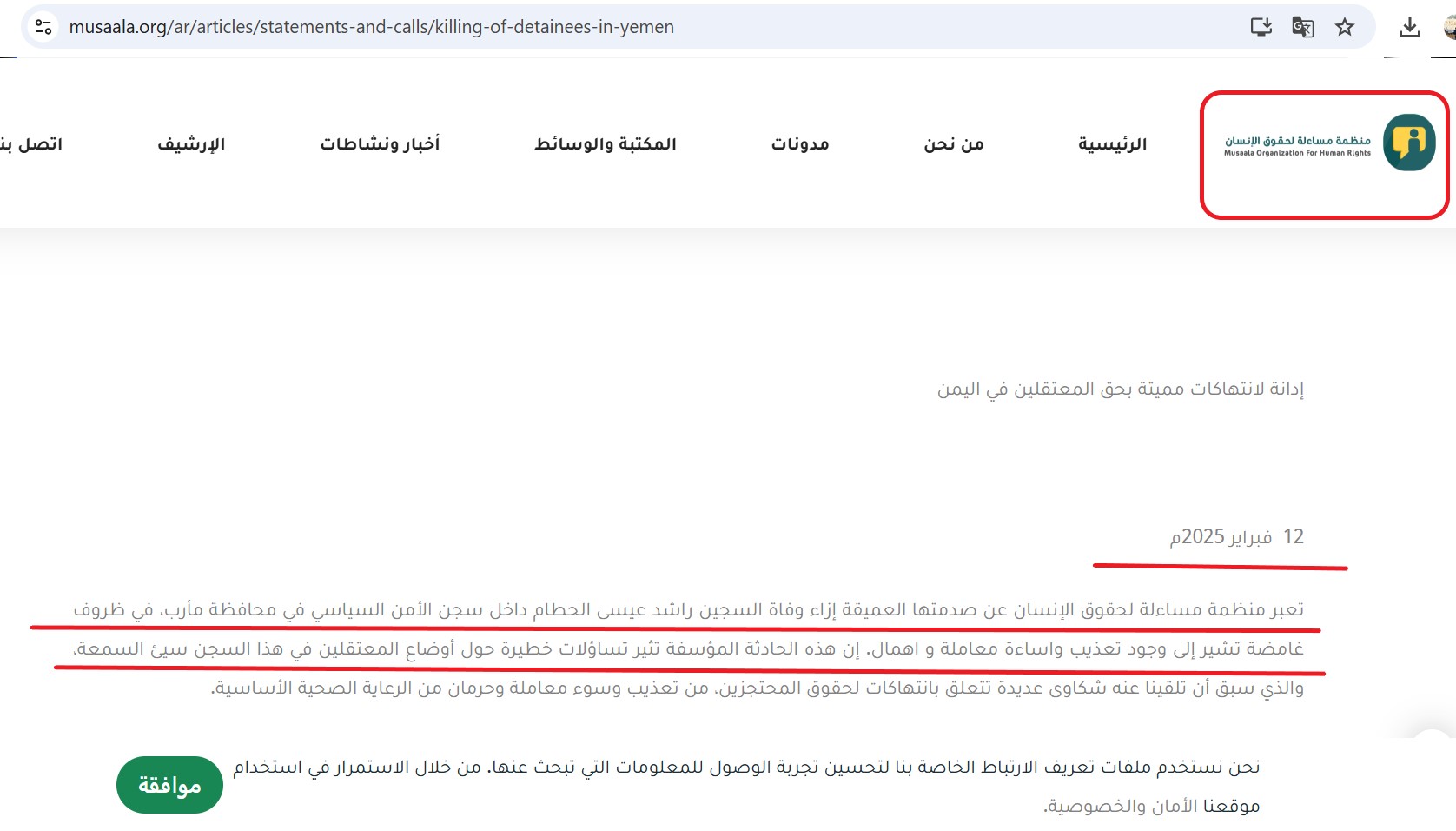
Attachment 10: Statement by the Accountability for Human Rights foundation on the Marib suicide case (falsely claimed torture and murder without evidence)
- Euphemistic Language:
Some reports use softened terminology to describe Houthi practices, such as “de facto authorities” instead of “Houthi militias.”
- Unrealistic Recommendations:
Some reports include impractical or inapplicable recommendations, given the current context in Yemen, weakening any potential roadmap for building a stable, democratic state.
Fifth: What Can Be Done?
- Reassessing International Priorities: The legitimate government must reassess the situation and develop its own plans for managing funds. The international community must also reconsider its priorities in Yemen by placing greater focus on state-building, justice, human rights, and good governance alongside counterterrorism. A clear vision for genuine peace should be adopted, and funding should be channeled through the Central Bank in Aden and transformed into development-oriented support.
- Supporting Institutional Reform: The international community must support efforts to reform Yemen’s institutions and strengthen the foundations of a functioning state.
- Holding Perpetrators Accountable: The international community must ensure that those responsible for war crimes and human rights violations in Yemen are held accountable, regardless of their affiliations or political identities.
- Inclusive Peace Process: The international community should ensure the participation of all Yemeni stakeholders in a genuine peace process, including political actors, civil society, and national experts. It must stop relying on the same individuals who have dominated the scene for over a decade and who, unfortunately, have contributed to the exclusion of others. These individuals must also be held accountable for the funding they have received.
- Supporting Transitional Justice Mechanisms: The international community must help develop inclusive and effective transitional justice mechanisms in Yemen. These should include fair trials, accountability for perpetrators, and compensation for victims.
- Empowering Local Civil Society and Communities: The international community must empower local Yemeni civil society to play a real role in peace and transitional justice processes and in the implementation of both humanitarian and development projects. This means prioritizing local civil society organizations within governorates, and not empowering or importing individuals or institutions from outside who falsely claim local ties yet lack real knowledge of the region’s customs, culture, needs, and priorities.
- Supporting Independent Media: Support should be extended to independent Yemeni media outlets and journalists who report on the conflict with fairness and integrity.
- Amplifying Independent Yemeni Voices: Give space to independent Yemeni voices that reflect the diverse perspectives of the Yemeni people.
- Verifying Information: Ensure that information published about Yemen is verified through multiple reliable and credible sources.
- Pressuring International Organizations and Enhancing Oversight and State Authority: There must be pressure on international organizations to guarantee that their reports and operations are neutral and objective, and that they do not serve specific political agendas. A comprehensive review, auditing, and accountability process for past and future funding must be established.
- Focusing on Good Governance: The international community must focus on building a Yemeni state rooted in the principles of good governance, including the rule of law, accountability, transparency, and civic participation.
Conclusion
Local and international factors are deeply intertwined in shaping Yemen’s future, with research and studies increasingly used as political tools that influence governance and transitional justice. It is essential to amplify local voices and uphold the core principles of justice to ensure a more stable and inclusive future.
In short, building the state, achieving good governance, and implementing transitional justice in Yemen require addressing conflicting international priorities, overcoming the double standards of political elites, ensuring accountability for crimes, compensating victims, and holding those who have manipulated international funding and projects accountable.
This also involves the meaningful inclusion of all national actors, local experts, and independent voices that truly represent the Yemeni people and have long been marginalized.
The solution also lies in exposing these lobbying networks, revealing their ties to the Houthis, and redirecting international efforts to support legitimate institutions through national expertise. At the same time, corrupt figures within the government and affiliated entities must be held accountable. It is crucial to reinforce the principles of governance and transparency, empower independent Yemeni voices, and urge the international community to distance itself from global corruption that perpetuates crises rather than resolving them.
Any settlement that does not center on restoring the state, dismantling militia power, and ensuring accountability for all parties will only reproduce the current status quo.
Report in PDF format
Legitimizing the Houthi Militia By Peace Lobbies and Directed Researches - 22 April 2025
