FraudWiki – June 2025
General Introduction
Yemen has long been a stage for complex conflicts interwoven with regional and international interests, but what lies beneath is even more significant. Behind the apparent scene of war, subtle threads of influence are being shaped, managed from the backrooms of international organizations and “peace” platforms, where narratives are crafted and events are rewritten to serve specific parties.
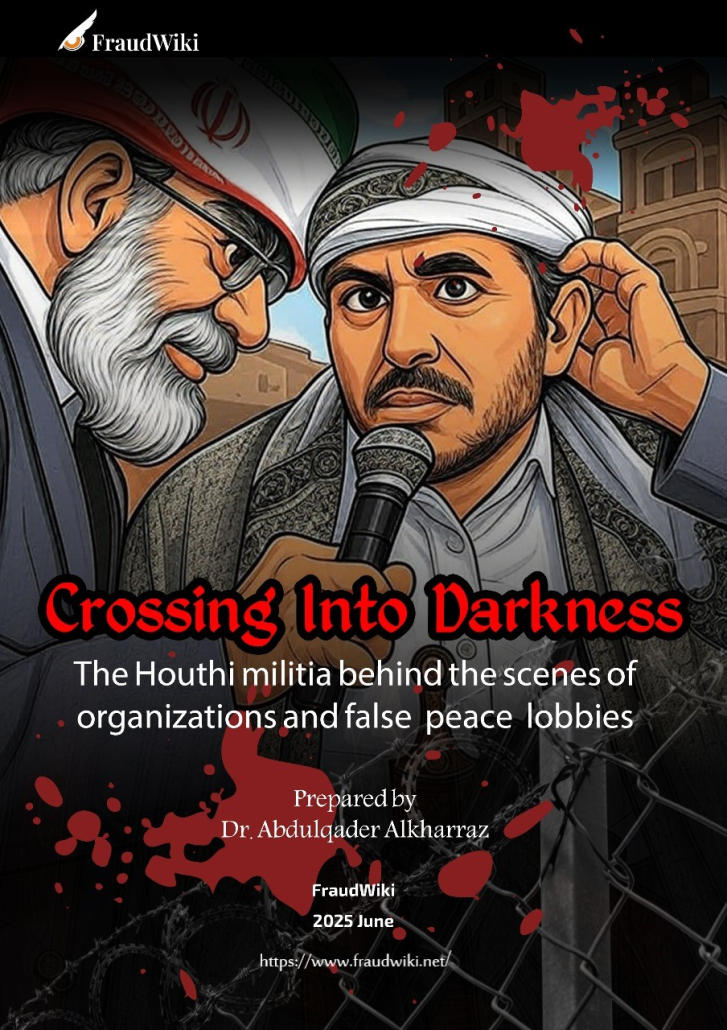
In this context, the Houthi militia emerges as one of the most prominent actors adept at manipulating truths and leveraging international community tools to reproduce their legitimacy and strengthen their grip on power. This book, “ Crossing into Darkness: The Houthi Militia Behind the Scenes of Organizations and False Peace Lobbyists,,” opens a window onto one of the most dangerous facets of the conflict in Yemen: the invisible networks linking the Houthis to UN and international organizations, and how these connections are used not only to prolong the war but also to undermine opportunities for just and comprehensive peace.
Through a detailed analysis of the Houthi secret organization’s methods, we explore how this group has infiltrated international institutions, taking advantage of gaps in the global system. We also highlight how false peace lobbyists serve as tools to justify the presence of the Houthis and enhance their influence in the political arena.
In today’s world, where humanitarian and political crises increasingly overlap, it is crucial to understand the factors influencing the complex Yemeni reality. This book presents reliable and accurate research findings compiled from our previous publications and reports released via the FraudWiki platform, shedding light on the dangerous role played by certain individuals associated with the Houthi group within international financial and humanitarian institutions, either directly or indirectly. This information has not only raised community awareness but also had direct impacts on international policies, leading to sanctions from the Security Council and U.S. sanctions on several individuals and entities included in the chapters of this book, in addition to forming international committees to investigate corruption in international funding provided in the name of humanitarian aid to Yemen during the war.
Methodology
Our methodology in this book is based on a comprehensive and multidimensional analysis. It relies on our previous reports over the years, gathering and analyzing reliable data, and using both quantitative and qualitative analysis methods to understand how the Houthis influence international narratives. Specific cases embodying these dynamics will be studied, providing clear insights into Houthi strategies and the services offered by members of the Houthi secret organization within international organizations, funds, false peace lobbyists, and highlighting key figures in the Houthi security and intelligence system and their roles and threats.
Objectives
This study aims to achieve several key objectives:
- Uncover Hidden Truths: Highlighting how the Houthis use international organizations as tools to enhance their influence.
- Analyze Strategies: Studying the methods employed by the Houthi militia to manipulate global narratives.
- Raise International Awareness: Providing a deeper understanding of the challenges facing security and peace in the region and urging the international community to take effective steps to address these threats.
- Provide Recommendations: Offering practical suggestions to counter the Houthi influence in international organizations and to enhance genuine peace efforts.
- Document History: Documenting events and facts related to the Houthis to serve as a reference for future generations, establishing solid evidence for accountability, contributing to preserving collective memory, and promoting justice in the future.
Structure of the Book
This book consists of three main parts divided into six integrated chapters, covering various aspects of the Houthi influence on the international stage. References and sources are allocated according to each section, allowing readers to delve into topics of particular interest.
The importance of this book lies in the context of the complex conflict in Yemen since 2015, where concerns about the Houthi group’s impact on international financial and humanitarian institutions are increasing. The book reviews, through its various chapters, the roles of individuals linked to the Houthis and how they exploit their positions to advance the interests of this group, reflecting a real threat to the integrity and neutrality of institutions aimed at providing humanitarian support amid escalating crises. Each chapter addresses a specific issue, from revealing influential individuals within international organizations to analyzing their impact on policies and funding, culminating in a study of the Houthi security and intelligence apparatus and its effect on the humanitarian situation. Additionally, the concept of international narrative engineering and how the international community has aligned with false peace lobbyists and targeted research as tools to legitimize the Houthis is discussed.
The book addresses how these figures have used their positions to enhance Houthi interests, threatening the integrity of international institutions and undermining humanitarian efforts aimed at alleviating the suffering of the Yemeni people. It also examines the impact of corruption and mismanagement on international financial flows and how these conditions have been exploited to distort the image of the legitimate government and present the Houthis as a de facto authority.
Through this book, we seek to issue an urgent call for accountability for those involved in corruption, whether at the level of organizations, the legitimate authority, or the Houthi militia, and to ensure transparency in the management of international aid while reducing Houthi influence in institutions aimed at supporting the Yemeni people. The failure of the international community to address these issues makes it necessary to reevaluate current policies and work towards restoring the Yemeni state and the rights of its citizens.
In the first Part, which includes the first and second chapters, we find that The first chapter presents increasing concerns about the presence of individuals linked to the Houthi group within international financial and humanitarian institutions. These individuals, who hold influential positions within the World Bank, the International Monetary Fund, and organizations claiming to advocate for human rights, use their positions to promote Houthi interests, threatening the integrity of these institutions. The chapter focuses on six key individuals identified through open-source research, detailing how they exploit their positions to channel resources and information in favor of the Houthi militia while utilizing lobbying platforms and coordinating public relations and propaganda. It also highlights the negative impact of these activities on humanitarian aid access, which lacks effective intervention from relevant government entities, necessitating action to ensure integrity, transparency, and accountability for international institutions, as well as for corrupt individuals within the legitimate government and holding the Houthi militia accountable.
The second chapter continues this analysis in detail, focusing on several other prominent figures associated with the Houthi group who play pivotal roles in international and local institutions in Yemen. It examines how these individuals serve Houthi interests and their influence on institutional decisions, exploring their functional roles and familial ties, with examples of their impact on international project funding. The chapter discusses the roles of individuals in the United Nations Office for the Coordination of Humanitarian Affairs in Sana’a (UNOCHA), the World Bank in Washington, UNICEF, and the Geneva Centre for Security Governance, and how they facilitate Houthi interests. It highlights conflicts of interest, resource mismanagement, manipulation of narratives, and information direction, urging action to hold the involved parties accountable and ensure transparency in aid management.
The second Part, comprising the third and fourth chapters, aims to provide an analysis of the Houthi security and intelligence apparatus, based on reliable information and sources collected over the years. The data has been verified up to the end of 2023, also relying on open sources. The Houthi militia has established a security and intelligence apparatus as a means to bolster its authority and control over the areas it governs. This apparatus collects information about allies and opponents, making it crucial to understand its structure and operational methods to assess the threats posed by the militia to local, regional, and international security. The Houthi militia is characterized by the rotation of individuals in key positions, which helps maintain operational security and conceal its strategies. This regular turnover creates an impression of stability while ensuring the protection of sensitive information and illicit operations, such as arms smuggling, recruitment, and money laundering.
Moreover, the Houthi security and intelligence apparatus significantly affects the work of international organizations in Yemen. The Houthi influence can interfere with relief and humanitarian assistance efforts, as working in Houthi-controlled areas requires adaptation to the security apparatus’s requirements, limiting organizations’ ability to operate freely and effectively. Additionally, some organizations and their personnel align with this apparatus’s demands and serve the militia. This section will spotlight the names and roles of key individuals within the apparatus and some entities associated with it, as well as their impact on the security and humanitarian landscape in Yemen, including issues of abduction, torture, arms smuggling, and recruitment in international wars.
In the third Part, we find in it the fifth chapter, we will examine the concept of international narrative engineering and how the international community has aligned with false peace lobbyists and targeted research as tools to legitimize the Houthis and undermine state-building and governance in Yemen, posing questions about the impact of these dynamics on the Yemeni scene. Additionally, the chapter addresses the humanitarian dimensions of the crisis, highlighting corruption and mismanagement as key factors hindering the effectiveness of international funding. Yemen has been experiencing a severe humanitarian crisis since 2015 due to ongoing conflict, leading to deteriorating economic and social conditions, increased poverty, and shortages of food and medicine. International funding is a key tool for addressing this crisis; however, it faces significant challenges such as corruption, mismanagement, and a lack of transparency, limiting its effectiveness in alleviating the suffering of the Yemeni people.
International funding to Yemen amounted to approximately $32 billion between 2015 and 2024, with the majority going to UN agencies such as the World Food Programme (WFP), UNICEF, and the United Nations Development Programme (UNDP), which have directly and indirectly supported the Houthi militia, in addition to hundreds of millions of dollars in funding from the European Union for projects under the guise of peace and justice. However, networks and research entities are presented as independent but actually support the Houthi agenda, contributing to redefining the Houthis as a legitimate political movement. These entities (such as the Mwatana Foundation, the Sana’a Center, and DeepRoot, among others) have manipulated facts and issued misleading reports, granting the Houthis unwarranted political cover. The international community has become complicit in the crisis, adhering to a negotiation track that divides power with the Houthis, ignoring that they are part of an Iranian expansionist project that seized power in Yemen by force. In this context, international reports serve as a tool to reshape the scene, disregarding national voices and supporting the interests of lobbyists linked to the Houthis.
Finally, the sixth chapter discusses how leaked security data has been used to distort the image of the legitimate government, revealing the extent of misinformation and data manipulation and how this contributes to enhancing the Houthis’ image as a stable authority—a misleading portrayal that hinders efforts to build peace in Yemen. The leaked incident data from organizations during the period from 2022 to 2023 poses a concern for the legitimate government in Yemen. Analyses show that the purpose of this data is to distort the image of legitimacy and justify the continued presence of certain organizations under Houthi control, engaging in information manipulation. The analyzed data includes a disclosure of 404 security incidents, prepared by the Yemen Humanitarian Coordination Office, and appears to be submitted annually without review by the legitimate government, necessitating verification of its accuracy and coordination of protective measures.
This data aligns with reports from organizations working in peace that distort facts and manipulate information, reinforcing the Houthis’ image as a party ready for peace while portraying the legitimate areas as unstable. This trend sends a false message to the world that legitimate areas are chaotic, making it easier to exploit these conditions to gather funds for specific institutions. This report provides an analysis of these leaked data and suggests measures to counter these risks.
The significance of this book lies in the fact that it is not merely a professional analysis, but a call to action. By providing reliable and comprehensive information, the book aims to raise international awareness about the threats posed by the Houthis and calls for effective action to hold those involved accountable and ensure transparency in aid management. Understanding these dynamics is key to effecting real change in the Yemeni situation and rebuilding the state in a manner that achieves justice and stability. This study is based on reliable data and sources to uncover the hidden dimensions of the conflict in Yemen, raising questions about the international community’s role in addressing these complex challenges. Join us on this journey into darkness as we unveil hidden truths, document history, and present the threats facing security and peace in the region.
General Conclusion
The importance of the reliable information and data presented in this book is evident in its ability to change societal awareness and even influence national policies. The previous reports and analyses included in this book have contributed to the adoption of many effective measures at the international level. Sanctions have been imposed by the Security Council on individuals linked to the Houthis, along with U.S. sanctions that reflect the seriousness of the international community in addressing these challenges.
The book reveals the infiltration of individuals connected to Houthi leadership into key positions within international humanitarian and financial organizations, undermining the principles of independence and neutrality. This situation raises doubts about these institutions’ ability to make objective decisions regarding Yemen and threatens to normalize a terrorist militia by exploiting international programs. It also raises questions about the protection of the vulnerable Yemeni population and the extent to which political agendas influence humanitarian priorities. Urgent investigations and strong reforms are required to close gaps and prevent future infiltration. The legitimate government should review its representatives in these organizations to ensure no negative impact on its legitimacy. Restoring credibility requires serious measures to maintain integrity and trust in humanitarian work.
This analysis also highlights the harmful roles played by individuals within international organizations in facilitating the Houthi militia’s agenda, thereby undermining the integrity of these institutions. Instead of maintaining neutrality, some have exploited their positions to obscure Houthi violations, casting doubt on the priorities of humanitarian work. Financial manipulation reveals gaps in oversight and strengthens the Houthis’ position through deliberate infiltration of international mechanisms. The lenient stances of UN agencies have allowed this infiltration to continue, harming the effectiveness of aid. It is crucial to take tangible steps to restore neutrality and accountability, focusing on the interests of the Yemeni people as a priority. Those government entities and civil organizations that support the Houthis and work to rescind their designation as a terrorist group must be held accountable.
The complex dynamics of Houthi militia operations reveal a multifaceted approach to governance, security, and international relations. The establishment of a security and intelligence apparatus has bolstered its authority through comprehensive monitoring strategies of supporters and opponents. Key figures such as Abdul Wahid Naji Muhammad Abu Ras and Hassan al-Kahlani play critical roles in coordinating intelligence activities and military operations, enhancing their grip on power. The militia’s use of shell companies, such as those coordinated by Ahmad al-Shami, or those managed by Abdul Wali al-Jabri, and Ali al-Hadi, reflects its ability to adapt in a complex conflict environment.
Regional security challenges persist through the involvement of political figures in illicit arms deals. Acts of kidnapping and torture against activists and international organization staff raise questions about accountability and the effectiveness of international human rights mechanisms. Furthermore, the involvement of some civil society institutions (Like DeepRoot and the Hikma Fellowship and Resonate Yemen) in presenting Houthi leaders as neutral figures hinders the true narrative of the Houthi militia.
As the situation in Yemen continues to evolve, understanding these dynamics is essential for grasping the Houthis’ impact on the conflict. International community efforts must address the humanitarian crisis comprehensively and effectively, emphasizing the importance of holding all parties accountable for their actions.
Local and international factors intersect in shaping Yemen’s future, as research is used as a political tool influencing governance and transitional justice. It is crucial to amplify genuine local voices and uphold the fundamental principles of justice to ensure a stable and inclusive future. Building the state requires addressing conflicting international priorities and ensuring accountability for crimes while compensating victims.
Lobbying groups that exploit peace and justice funding to beautify and empower the Houthi militia and contribute to obstructing international sanctions must be exposed, and their connections to the Houthis must be exposed (such as the Mwatana Foundation and the Sana’a Center for Studies), with a redirection of international efforts to support legitimate institutions. Additionally, corrupt individuals should be held accountable, and principles of governance and transparency must be enhanced. Any settlement that does not focus on state restoration and dismantling militia power will only perpetuate the status quo.
The analytical model highlights the risks of misinformation in security incident data threatening the legitimate government, such as damaging its image and diminishing donor trust. To mitigate these risks, restructuring relationships with international organizations to enhance coordination and transparency is advised. Monitoring mechanisms on relevant institutions should be activated, and all funding should be deposited in the Central Bank in Aden. Furthermore, organization data should be reviewed before publication and approved by relevant government entities. Responsible officials should be held accountable, and government personnel should be replaced with qualified individuals who have a national allegiance, working to improve the situation and better direct funding for the benefit of Yemenis.
Proposed Actions:
- Resetting Relationships: Adjust relationships with international organizations and UN agencies to effectively serve humanitarian work and transition to developmental projects.
- Activating Monitoring Mechanisms: Enhance coordination and accountability for UN agencies, international organizations, and relevant institutions, holding them accountable for previous amounts that reached $32 billion and reviewing their reports.
- Funding Deposits: Enforce the deposit of all international funding into the Central Bank in Aden, contributing to national economic improvement and limiting support for the Houthi militia.
- Activating the Electronic System: Reactivate the monitoring and follow-up system for projects linking the Central Bank, Ministry of Finance, Ministry of Planning, UN agencies, international organizations, and executive project units in the governorates.
- Report Review: No reports or data should be published by organizations without prior review and approval from relevant government entities.
- Accountability of Officials: Work to hold accountable government officials affiliated with legitimacy and make changes with qualified personnel who have a national allegiance, working to repair the situation and better direct funding for the benefit of Yemenis.
- Regulating Local and International Institutions: Require local institutions working in human rights, relief, and training to submit detailed reports and hold them accountable for funds received, with monitoring and review of their reports. Also, institutions registered outside Yemen working in relief or peace projects with international organizations or donors must provide detailed reports and be held accountable for previously received funds and any actions that have harmed the community in Yemen or the legitimacy’s image globally or exploited the suffering of Yemenis for personal gain, including collusion among a limited number to control funding.
- Opening Dialogue Channels: Strengthen dialogue among all parties involved, including civil society, to ensure all voices are heard in decision-making processes. Additionally, empower genuine Yemeni voices to reach international platforms, encourage research and studies that neutrally highlight violations and provide effective solutions, thereby raising public awareness and prompting the international community to take action.
In conclusion, any settlement that does not focus on state restoration, dismantling militia power, and holding all parties accountable will merely reproduce the status quo.